TL;DR: Pico Prism 2.1 proves 99.9% of Ethereum mainnet blocks in under 10 seconds at the network’s current 60M gas limit, clearing the Ethereum Foundation’s real-time proving target. Across 7,200 consecutive blocks it averages 4.87 seconds end to end, with a P99 of 9.14 seconds, on the same two-machine, 16-GPU setup we ran for Pico Prism 2.0. Most of the improvement was found and written by AutoEng, our autonomous AI engineering agent. As always, the benchmark is fully reproducible and the stack stays open source.
The Road to Real-Time
Real-time proving has been the defining race of the zkVM space for the past two years, and Pico Prism has spent most of that time at the front of it. When we introduced Pico Prism in October 2025, it became the first system to prove Ethereum L1 blocks in real time on consumer hardware, covering 96.8% of 45 million gas blocks under ten seconds at more than three times the efficiency of the previous state of the art. A few months later we held that same performance while cutting the cluster from 64 GPUs down to 16, which brought total hardware cost to around $100K and put us right on the Ethereum Foundation’s capex target for home proving. In May, Pico Prism 2.0 rebuilt the prover almost from the ground up for a 5.3x efficiency gain, keeping pace with Ethereum’s heavier 60 million gas blocks at a 6.1 second average.
Each of those releases cleared the bar as it stood. However, gas limits have climbed from 36 million to 45 million to 60 million over time, with 100 million already on the roadmap, and every increase makes blocks heavier and the proving window tighter. A target that looks settled at one gas limit reopens at the next. That is the nature of building for a network that keeps scaling, and it is why the strict real-time threshold was still left for us to conquer at 60 million gas.
The Real-Time Bar
The Ethereum Foundation set that threshold with some precision. In its July 2025 roadmap, Shipping an L1 zkEVM: Realtime Proving, it defined real-time proving as a proof produced in ten seconds or less. The number comes straight from Ethereum’s own timing, since a twelve second slot minus roughly a second and a half of network propagation leaves a prover about ten seconds to keep up with the chain, and to count, a zkVM has to clear that window on at least 99% of mainnet blocks.
At 45 million gas we were comfortably inside it. At 60 million gas the heavier blocks pushed our tail latency back over the line, and while Pico Prism 2.0 still finalized 99.9% of blocks within the full twelve second slot, the tighter ten second real-time window was the one target we had not yet reclaimed.
Pico Prism 2.1 reclaims it.
The Results
We benchmarked Pico Prism 2.1 on 7,200 consecutive Ethereum mainnet blocks, blocks 24,000,000 through 24,007,199, using the same hardware as our 2.0 benchmark: two machines with eight GPUs each, 16 in total. Across that run:
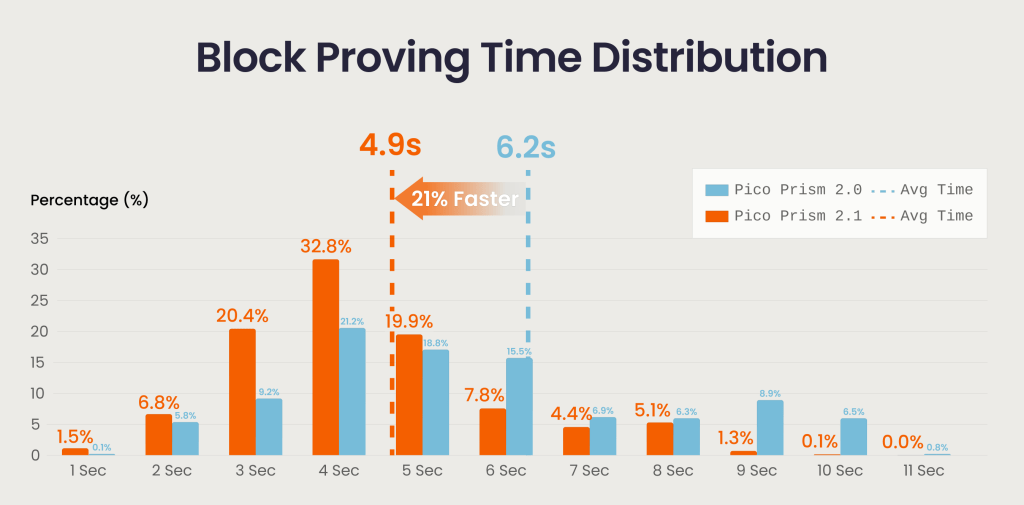
- 4.87 seconds mean end-to-end proving time
- 9.14 seconds P99 proving time
- 99.9% of blocks proven within 10 seconds (the Ethereum Foundation’s bar is 99%)
- 100% of blocks proven within Ethereum’s 12-second slot
Measured against Pico Prism 2.0, which averaged 6.1 seconds on the same setup, that is a reduction of more than 20% in average proving time with no additional hardware. The improvement lives entirely in the software, and it shows across the whole distribution rather than in any single bucket, with the 2.1 curve sitting a full second to the left of 2.0 and the tail that used to spill past ten seconds now pulled inside the window.
How We Got There: AutoEng
What sets this release apart from the ones before it is who did most of the engineering. The largest share of the speedup was found and written by AutoEng, the autonomous optimization agent we introduced in July.
AutoEng proved its value almost as soon as we announced it. In its first outing it found an 11% end-to-end speedup on Pico, a system that had already been tuned for years and was running at the frontier, and it did so in under three days with no one steering it. We left it running against the proving stack, and over thousands of iterations across both the GPU kernels and the CPU orchestration it kept profiling the live prover, proposing changes, testing them, and keeping only the ones that measured faster. The gains that carried Pico Prism the last stretch to the real-time target came out of that process, accumulated a fraction of a percent at a time rather than from any single breakthrough.
The reason we let an agent touch a system this sensitive is that it is never allowed to grade its own work. AutoEng can propose whatever change it likes, but a candidate survives only when the measurement agrees, with correctness verified byte for byte against the reference and speed decided by deterministic benchmarks. Anything that fails either check is discarded automatically, with no engineer in the loop to be talked into it. Optimizing a mature system is one of the slowest crafts in software, the kind of work where a specialist can spend weeks to win a fraction of a percent, and AutoEng does it continuously at a pace no team could ever staff for.
Where Zero-Knowledge Meets AI
Pico Prism 2.1 is a real-time proving milestone, and it is also a sign of how we intend to build from here. Brevis works within two of the fastest-moving fields in computing, zero-knowledge proofs and frontier AI, and this release is what happens when the two reinforce each other. The verification discipline that makes a ZK proof worth trusting is the same thing that let us hand the tuning of a live Ethereum prover to an autonomous agent in the first place, since every change it proposed had to earn its place on the benchmark before it counted. The AI drove the performance and ZK-grade verification kept it honest, and each side came out stronger for it.
What makes that pairing work is expertise on both ends. A tool like AutoEng is only as sharp as the people aiming it, and a team that understands a system as intricate as a zkVM at the depth ours does can point it at the problems that actually matter and recognize a real result when it appears. Put that kind of domain knowledge together with the current generation of AI, and challenges that used to demand rare specialists over long stretches of time start to give way far faster. What would once have taken a team of experts months now lands in a small fraction of that.
We are early in this, and we intend to keep pointing AutoEng at Pico and at far harder problems beyond it.
About Brevis
Brevis is a verifiable computing platform powered by zero-knowledge proofs, serving as the infinite compute layer for Web3 and beyond. Applications can offload expensive computation off-chain while proving every result on-chain. The Brevis stack includes Pico zkVM for general-purpose computation, which in its 3.0 release proves Ethereum blocks in real time on a single machine with 4 GPUs and 100 bits of provable security; the ZK Data Coprocessor for trustless access to historical blockchain data; Vera for ZK-proven media authenticity; and ProverNet, the decentralized marketplace for ZK proof generation, live on mainnet. To date, Brevis has generated nearly 400 million proofs across 50+ protocols on 14 blockchains.
Dive Deeper into Brevis:
Website | X | Discord | Pico zkVM | ZK Data Coprocessor | Incentra | ProverNet | Vera | Arca
Interested in building with Brevis? Reach out to us to explore ideas!

