

TL;DR: Pico 3.1 takes provable security from 100 to 128 bits, with final proofs of 300 KB or less, matching the Ethereum Foundation’s end-of-2026 targets for zkEVM security and proof size. It stays real-time on a single machine with 4 RTX 5090 GPUs: on the same 7,200 mainnet blocks, it proves 99% of them within 8.73 seconds, against 9.10 seconds for Pico 3.0. And Pico’s entire proving stack, CPU and GPU, is now open source under the MIT and Apache 2.0 licenses.
Secure, Compact, and Still Real-Time
A year ago, real-time Ethereum proving took us 64 GPUs across eight servers. Pico 3.0 brought it down to 4 GPUs on a single machine.
That was a major step toward making real-time proving affordable and accessible. But speed is only part of the challenge.
For Ethereum to eventually use zero-knowledge proofs to verify block execution, the underlying proof systems must also be cryptographically secure, produce compact proofs, and be open to independent inspection.
With Pico 3.1, we’re delivering on all three fronts.
128-Bit Provable Security and Proofs Under 300 KB
Pico 3.0 introduced a completely new proving core with 100 bits of provable security. Pico 3.1 raises that to 128 bits, with final proofs at or below 300 KB .
Provable security means that we can mathematically bound how difficult it is for an attacker to produce a convincing proof of an incorrect computation, rather than relying on unproven conjectures. Every extra bit doubles the work an attacker would need, so moving from 100 to 128 bits makes a forged proof about 268 million times harder to produce.
Proof size matters just as much. Ethereum blocks contain large amounts of computation, but a zero-knowledge proof allows that computation to be verified without executing it all over again. The smaller the final proof, the easier it is to distribute, store, and verify across the network.
Achieving stronger security and smaller proofs simultaneously is challenging: increasing security typically requires more cryptographic work and can make proofs larger.
These two milestones directly match the Ethereum Foundation’s published end-of-2026 targets for zkEVM security and proof size.
Still Real-Time, on Just 4 GPUs
Stronger security and compact proofs would mean much less if they came at the cost of real-time performance.
Pico 3.1 maintains real-time proving on a single machine equipped with just 4 NVIDIA RTX 5090 GPUs.
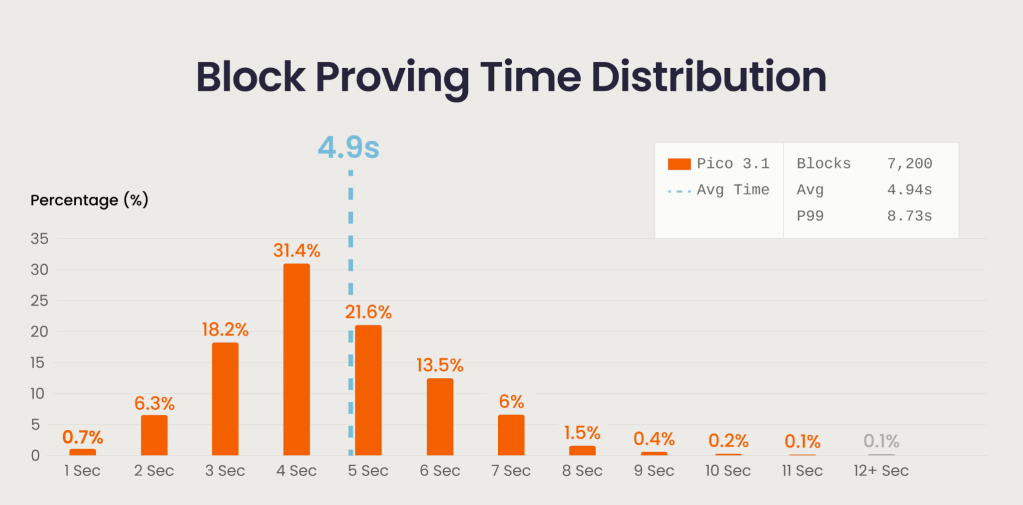
We evaluated its proving performance on 7,200 consecutive Ethereum mainnet blocks (24,000,000 through 24,007,199), the same benchmark dataset used in our previous releases.
The results:
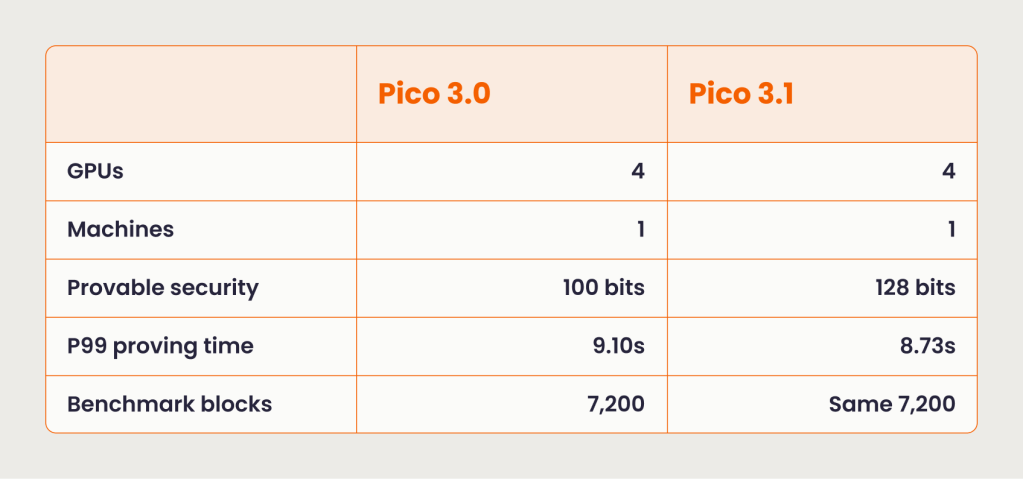
This keeps Pico comfortably within the ten-second real-time window, even with its significantly stronger security guarantees.
Engineering a More Efficient Prover
Maintaining this performance while strengthening security required further optimization throughout Pico’s proving pipeline.
A zkVM works by executing a program, recording what happened, and generating a cryptographic proof that the execution was correct. For large workloads such as Ethereum blocks, this involves processing enormous amounts of execution data and distributing the proving work across multiple GPUs.
With Pico 3.1, we optimized both how much work the prover needs to perform and how efficiently the hardware performs it.
Four improvements stand out:
- Simpler circuits, fewer computations. We redesigned the rules that describe correct program execution, reducing their mathematical complexity and the amount of work needed to check them. Across our RISC-V circuits, the constraint degree dropped from 4 to 3. We also reduced CPU constraint size by 34% and memory-access constraint size by 27%, making the underlying proving workload significantly lighter.
- Less bookkeeping and smaller execution traces. A large part of proving involves checking that different parts of a program’s execution are consistent with one another. By redesigning how these relationships are represented, we reduced the number of required interactions by 43% for CPU operations and up to 45% for memory operations. For workloads involving cryptographic precompiles, we also reduced memory trace rows by up to 50%.
- Keeping GPUs busy instead of waiting. Profiling revealed that GPUs were frequently sitting idle while waiting for CPU-side preparation or unnecessary synchronization. We moved data preparation earlier in the pipeline, eliminated redundant scans, and improved GPU memory management. Together, these changes reduced GPU idle time during trace generation by 76% on a benchmark of 80 blocks near the P99 tail, relative to the preceding optimized version.
- Smarter scheduling across GPUs. Not all pieces of an Ethereum block take the same time to prove. We accelerated transaction signature processing and introduced cost-aware scheduling that assigns expensive proving tasks first, allowing smaller tasks to fill the remaining gaps. This reduced the finishing-time imbalance across GPUs by approximately 80% and improved end-to-end proving time by 5.9% on the same 80-block benchmark.
Together, these improvements reflect a central principle behind Pico’s design: speed comes as much from cutting unnecessary work across the whole system as from faster cryptography.
Fully Open Source: From CPU to GPU
Another major milestone of Pico 3.1 is that the entire Pico proving implementation is now open source, including both CPU and GPU code.
Pico has always been built around modularity and openness. With the release of our GPU proving implementation, developers and researchers can now inspect the full proving pipeline, from program execution and proof generation to the GPU kernels responsible for accelerating the most computationally intensive operations.
Both implementations are available on GitHub:
- Pico zkVM (CPU and core proving stack): https://github.com/brevis-network/pico
- Pico GPU: https://github.com/brevis-network/pico-gpu
Both are released under the permissive MIT and Apache 2.0 licenses, so anyone can use, modify, and build on the code, including in commercial products.
We believe open source is essential for building trustworthy zero-knowledge infrastructure. It enables independent security review, reproducible performance benchmarks, and collaboration across the broader Ethereum ecosystem.
More importantly, it gives developers direct access to the technology behind real-time proving, allowing them to build on it, optimize it, and adapt it to new applications.
Beyond Real-Time: Building Production-Ready ZK Infrastructure
Over the past year, Pico has made progress on multiple fronts: reducing the hardware required for real-time proving from 64 GPUs to just 4, introducing a new proving architecture, and now reaching 128-bit provable security with compact proofs.
Whether Ethereum can be proven in real time is no longer the question.
The next challenge is to make real-time proving secure, efficient, transparent, and accessible enough to serve as foundational infrastructure for Ethereum and the broader verifiable computing ecosystem.
Pico 3.1 is our biggest step toward that yet, and the first anyone can verify line by line.
About Brevis
Brevis is a verifiable computing platform powered by zero-knowledge proofs, serving as the infinite compute layer for Web3 and beyond. Applications can offload expensive computation off-chain while proving every result on-chain. The Brevis stack includes Pico zkVM for general-purpose computation, which in its 3.1 release proves Ethereum blocks in real time on a single machine with 4 GPUs and 128 bits of provable security, and is fully open source; the ZK Data Coprocessor for trustless access to historical blockchain data; Vera for ZK-proven media authenticity; and ProverNet, the decentralized marketplace for ZK proof generation, live on mainnet. To date, Brevis has generated nearly 400 million proofs across 50+ protocols on 14 blockchains.
Dive Deeper into Brevis:
Website | X | Discord | Pico zkVM | ZK Data Coprocessor | Incentra | ProverNet | Vera | Arca
Interested in building with Brevis? Reach out to us to explore ideas!

