TL;DR
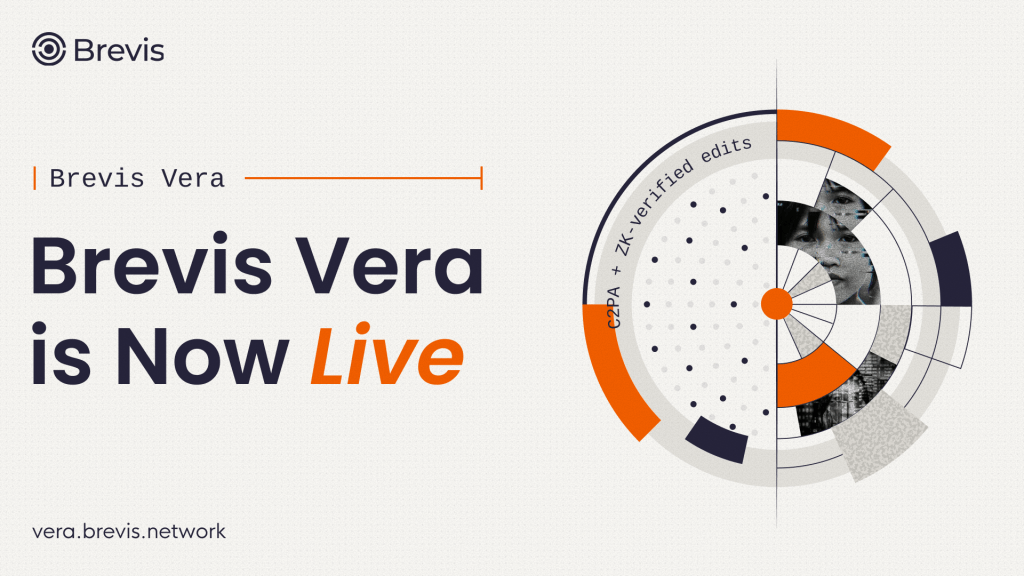
Brevis Vera is now open for anyone to use end-to-end at vera.brevis.network. Capture an image on any C2PA-enabled camera or phone, bring it into Vera, apply edits that get cryptographically attested as legitimate, and download a proof file that anyone in the world can verify in their own browser. Vera introduces zero-knowledge proofs as a new primitive in the C2PA stack, designed to preserve the privacy of both the source media and the editing process across the full chain of custody.
From Concept Demo to Working Tool
In March, we introduced Brevis Vera with an interactive demo that walked visitors through the idea: hardware-backed capture, zero-knowledge proofs of every edit, browser-side verification. The concept landed, but the tool was only a guided illustration at that point.
Today, the full version is open!
Anyone with a C2PA-enabled device can capture a real image, sign it at the source, bring it into Vera, apply real edits that get cryptographically attested, and produce a proof that any third party can verify on the spot. The same site that previously walked you through the concept now lets you run the workflow on your own photos.
What the Working Tool Does
The Editor accepts a C2PA-signed source image and surfaces the capture metadata: issuer, public key, signature, image hash. From there you apply a growing set of supported transformations: crop, exposure, color adjustments, brightness, denoise, and other edits working photographers reach for first. Each edit you make becomes part of the provable edit path.
When you’re ready to publish, Vera generates a single proof file in the background. The proof captures the original signature, every transformation applied, and the chain that ties one to the other. You walk away with two files: the edited image as a PNG, and the proof as a .bvproof file.
The Verifier is a separate flow. Anyone can upload an edited image plus its proof file and within seconds get a cryptographic confirmation that the image traces back to a real capture device, that only the disclosed transformations were applied, and that nothing was hidden or added along the way. Verification happens entirely in the browser.
Where ZK Adds to the C2PA Stack
C2PA support is already showing up in the editing tools photographers use most. Editor tools like Adobe Photoshop sign in-app edits either through a key embedded locally in the application or through their own cloud servers. Both work, and both have known tradeoffs. The local-signing path exposes the signing key to reverse engineering, and the cloud-signing path involves uploading sensitive data to a third-party server, potentially including the original media and the full edit history.
Vera’s ZK approach removes the extractable signing key problem entirely. The privacy benefit, where source media and editorial workflow stay private through the signing process, is realized when ZK proof generation is embedded inside local editor tools. We’ve built Vera as a complementary primitive that existing editing tools could adopt as the C2PA ecosystem matures, rather than as a competitive replacement.
Why It Matters Now That It Works
The March announcement made the case for the broader category shift: away from detecting fakes after the fact, and toward proving provenance from the source. With the tool open to everyone and the ZK primitive starting to surface as a real upgrade path for the C2PA stack, that shift becomes practical.
A photojournalist filing from the field can publish images that come with cryptographic proof of where they were captured and how they were processed, in a way that an editor, a lawyer, or a reader can verify independently. A stock photo platform can require provable provenance on submissions and run the check automatically. A platform fact-checking team can verify a viral image without trusting any of the parties that handled it on the way in. Once a proof exists, none of these workflows require Brevis or any other party to be in the loop. The proof speaks for itself, and anyone can verify it in their own browser.
Get Started
Try it: vera.brevis.network.
If your camera or phone hasn’t been set up for C2PA yet, we put together a short guide covering the most common devices and how to switch on the feature: C2PA Setup Guide.
Or try Vera right now with this sample image.
The reference implementation is open source on GitHub.
What’s Next
Over the coming weeks, you’ll start seeing Vera in the hands of professional photographers working across nature, wildlife, portrait, and editorial photography. They’ve been part of a private pilot, and as the launch week unfolds they’ll be posting their own captures, edits, and proofs to their own audiences with their own take on what verifiable provenance changes about working with photographs in 2026. We’re also lining up a series of podcasts and conversations with the same group, starting this week.
That photographer wave is a demonstration of what becomes possible when zero-knowledge proofs join the C2PA standard. Brevis is in the business of building the best ZK technology in the world, not the next photo editor. Our real goal with Vera is to establish ZK as a primitive in the C2PA stack and to see it adopted by the editing tools, camera manufacturers, and platforms already participating in the ecosystem. The security and privacy gains introduced by our ZK technology merit a reimagining of how the industry operates.
If you’re a creator, publisher, or platform interested in building on Vera, reach out through the partner form.

