TL;DR: Unitas, the delta-neutral yield infrastructure protocol behind USDu, has shipped cryptographic Proof of Reserves built with Primus and Brevis. The system verifies both halves of the reserve stack from day one: on-chain yield and liquidity positions on BSC, alongside the larger centralized exchange leg that holds Unitas’s hedge positions on Binance or other exchanges. Reserve totals, USDu supply, and the backing ratio are continuously updated and publicly verifiable at https://por.primuslabs.xyz/unitas, with USDu maintained as overcollateralized and the off-chain leg making up the majority share by design.
Why Delta-Neutral Reserves Have Been Hard to Verify
Yield-bearing stablecoins built on delta-neutral strategies share an awkward verification problem. The hedge sits on centralized exchanges. That structural placement is fundamental to how delta-neutral strategies work: long spot exposure sits on-chain, short perpetual positions sit on a CEX to hedge it, and the funding rate captured on the perp side becomes the yield. The trade works because centralized exchanges offer liquid perpetual markets that on-chain venues can’t yet match.
The trouble is that the bigger half of the collateral lives behind authenticated API endpoints, not in publicly visible smart contract state. There’s no block explorer for a Binance balance. A protocol can publish wallet addresses, but addresses say nothing about the perpetual positions that close the hedge. Older approaches to closing this verification gap have always been compromises: periodic third-party auditor attestations that lag the live state, self-disclosed screenshots that prove nothing cryptographically, or oracle-based feeds that just shift the trust assumption to whoever runs the oracle.
Unitas wired up real-time verification across both the on-chain and off-chain legs of its reserves at launch, and the off-chain leg is the part that matters most for a delta-neutral protocol.
The Verification Stack
Three pieces of infrastructure carry the work, each handling a layer of the problem.
Primus’s zkTLS sits at the data retrieval boundary. When the system pulls a USDu hedge balance from Binance, the response carries a zero-knowledge proof that it came over a real authenticated TLS session with the actual exchange. API keys and raw account details remain private, but the data itself becomes provable. zkTLS resolves the question of where reserves actually are.
Once data is retrieved, it passes through a Trusted Execution Environment. The TEE keeps the underlying balance figures confidential while it commits them onto a secure channel toward the proving network. Nothing about individual positions is exposed in transit, and the values that get committed are guaranteed to match the values that came out of the zkTLS layer.
The committed data flows into Brevis’s Pico zkVM, where the actual reserve computation happens. Pico aggregates balances across all sources, applies whatever logic Unitas needs to translate raw positions into a normalized USD figure, and produces a single zero-knowledge proof attesting that the disclosed reserve total was computed correctly from the authenticated inputs. That proof is what surfaces on the public dashboard. The math is checkable, the inputs stay private, and the user reading the dashboard does not need to extend trust to Unitas, Primus, or Brevis at any point in the chain.
What Holders See Today
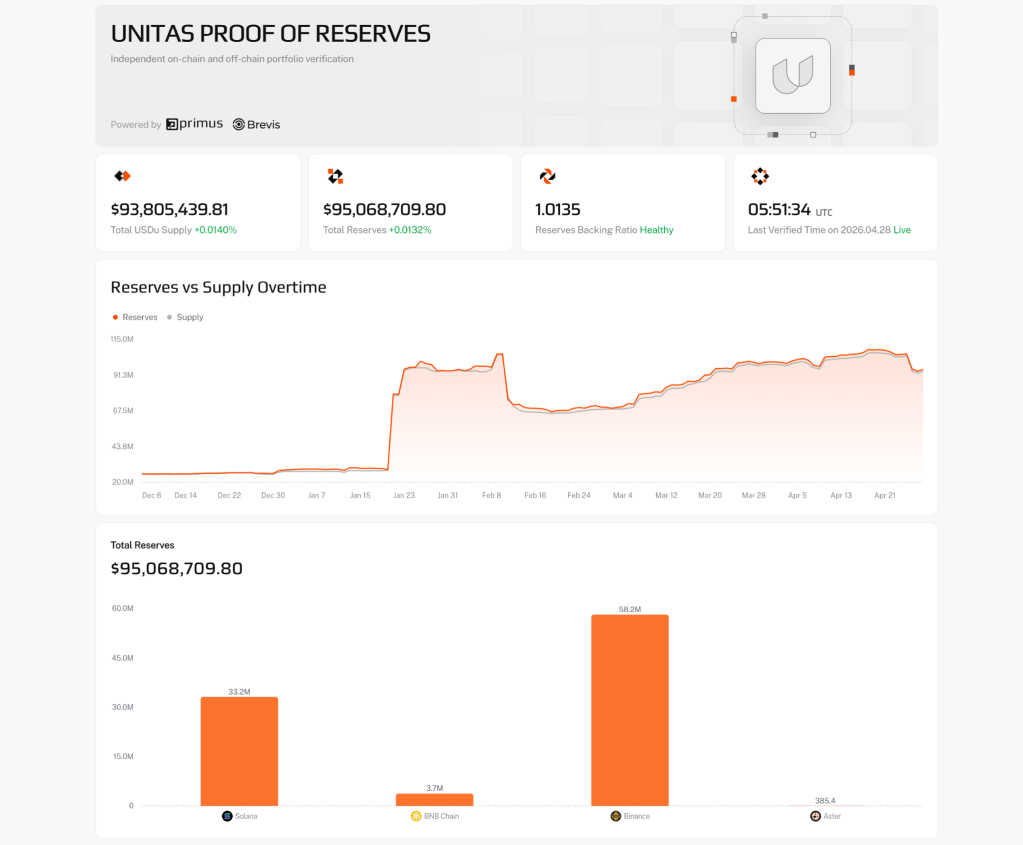
The live dashboard at por.primuslabs.xyz/unitas pulls everything together into a single page that updates continuously. USDu holders see verified reserve totals, current supply, the reserves-to-supply backing ratio, and the breakdown between the on-chain and off-chain legs of the collateral, all derived from the underlying proofs. The on-chain leg covers Unitas’s yield and liquidity exposure on BNB and other supported chains. The off-chain leg covers the hedge collateral held on Binance and other supported exchanges, which under delta-neutral economics typically carries the larger absolute exposure because it funds the perpetual hedge.
For USDu holders, the dashboard transforms the reserve question from a protocol claim into a cryptographic readout. The number on the page is the output of an aggregation that authenticated every input. Older Proof of Reserves approaches relied on batch attestations, periodic auditor reports, or oracle-style trust delegation. The proof model replaces all three with continuous cryptographic verification.
What Comes Next for Verifiable Yield
Proving reserves for delta-neutral protocols was the longer-deferred half of the broader stablecoin verification problem. Most projects shipped on-chain coverage years before they had any way to prove the off-chain side. Unitas launching with both halves live raises the floor for what users can reasonably expect from a yield-bearing dollar, especially one whose yield comes from CEX-held funding rate capture.
The same stack carries cleanly to any reserve-backed protocol with similar architecture, whether the yield strategy is delta-neutral or something else entirely. zkTLS authenticates the data, TEE protects it during processing, and Pico zkVM proves the final aggregation. None of those primitives are tied to USDu specifically. They compose into a Proof of Reserves layer that any protocol with reserves spanning on-chain and off-chain venues can adopt.
For USDu holders, the most concrete benefit is direct. The reserves backing their position get continuously verified by cryptographic proof, with the proof itself acting as the source of truth on the dashboard.
About Brevis
Brevis is a verifiable computing platform powered by zero-knowledge proofs, serving as the infinite compute layer for Web3 and beyond. Applications can offload expensive computation off-chain while proving every result on-chain. The Brevis stack includes Pico zkVM for general-purpose computation, which in its 3.0 release proves Ethereum blocks in real time on a single machine with 4 GPUs and 100 bits of provable security; the ZK Data Coprocessor for trustless access to historical blockchain data; Vera for ZK-proven media authenticity; and ProverNet, the decentralized marketplace for ZK proof generation, live on mainnet. To date, Brevis has generated nearly 400 million proofs across 50+ protocols on 14 blockchains.
Dive Deeper into Brevis:
Website | X | Discord | Pico zkVM | ZK Data Coprocessor | Incentra | ProverNet | Vera | Arca
Interested in building with Brevis? Reach out to us to explore ideas!

