
TL;DR: Pico 3.2 implements all ten Ethereum zkVM standards and passes 100% of the compliance tests: 72/72 RISC-V tests and 53/53 zkVM standards tests. We have also completed the formal verification of Pico’s core RISC-V circuits using Lean 4 against the official Sail RISC-V specification. With a new global LogUp-based memory check, every proving layer before the final wrapper now relies only on hash-based cryptography, a significant step toward post-quantum security. Pico 3.2 is also faster: P99 proving time drops from 8.73 to 7.59 seconds on the same four RTX 5090 GPUs, while keeping 128-bit provable security and final proofs under 300 KiB.
Meeting Ethereum’s zkVM Standards
The Ethereum Foundation’s zkVM Handbook sets out the criteria a zkVM must meet before the EF considers it ready for EIP-8025 Optional Proofs. The first three: implement the EF’s zkVM standards, pass every test on its public zkVM Test Monitor, and use formal methods to prove its circuits correct.
Pico 3.2 delivers on all three: full standards compliance, a 100% pass rate on both test suites, and formal verification of its core RISC-V circuits.
100% Pass Rate on Ethereum’s zkVM Compliance Tests
The Ethereum Foundation’s zkVM standards establish a common execution environment and standardized interfaces across different zkVM implementations, enabling developers to build applications that are portable across proving systems.
Pico now implements all ten published zkVM standards and achieves a 100% pass rate on both test suites tracked by the Ethereum Foundation’s public zkVM Test Monitor:
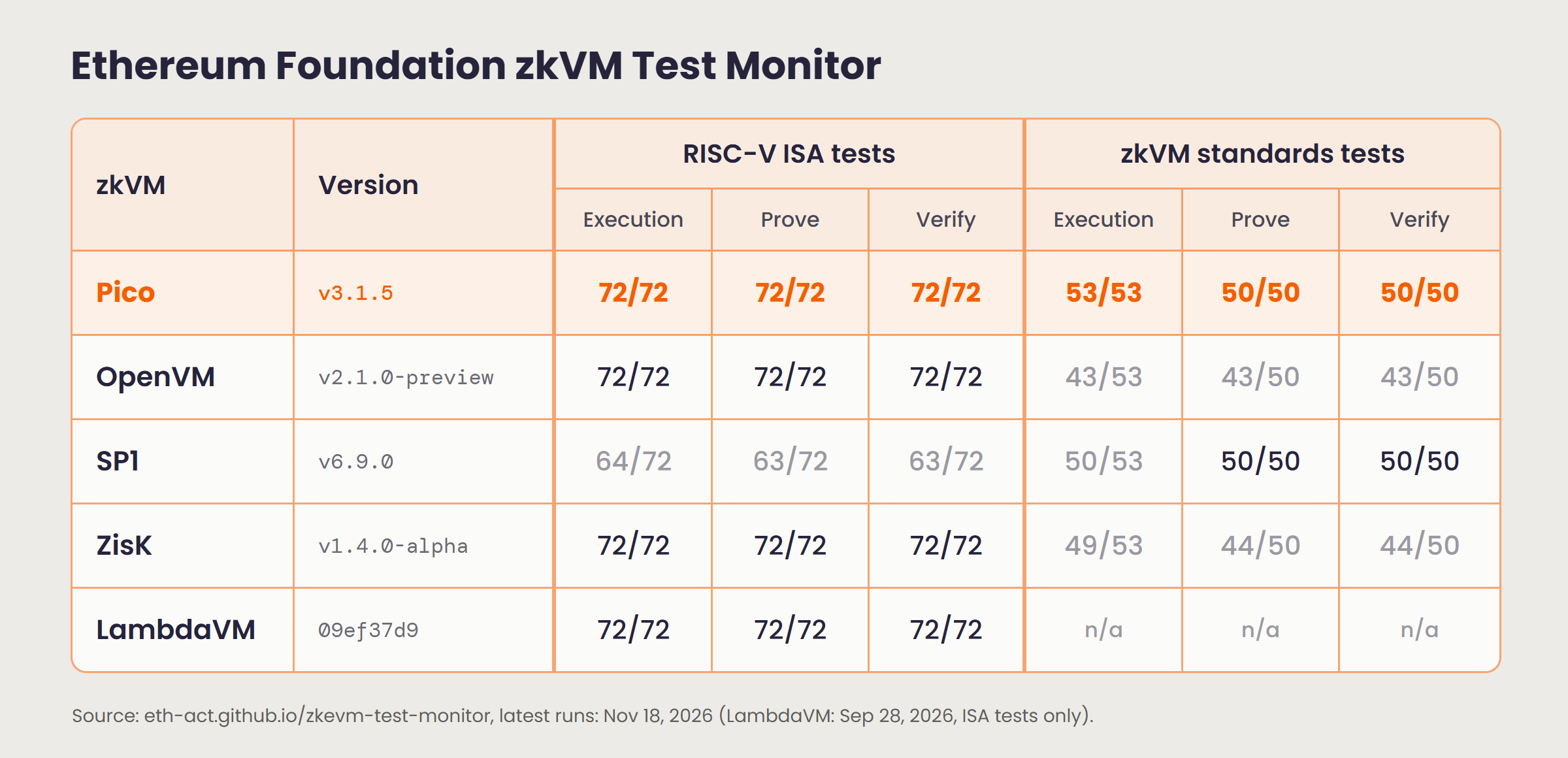
- 72/72 RISC-V architecture tests passed, covering the standardized 64-bit RISC-V execution environment.
- 53/53 zkVM standards tests passed, covering standardized I/O, cryptographic accelerators, and memory operations.
These results are reflected in the public Test Monitor for Pico 3.1.5, and Pico 3.2 has independently passed the complete test suite using the same testing framework.
Achieving full compliance required substantial engineering across Pico’s execution engine, memory subsystem, cryptographic accelerators, guest runtime, and GPU prover.
Beyond compatibility, these standards establish a critical foundation for Ethereum’s multi-prover ecosystem, where different zkVMs can independently prove the same execution under a shared specification.
Completed Formal Verification of Core RISC-V Circuits
Formal verification is another key requirement outlined in the Ethereum Foundation’s zkVM Handbook, providing mathematical correctness guarantees beyond what conventional testing alone can offer.
With Pico 3.2, we have completed the formal verification of Pico’s core RISC-V execution circuits using Lean 4 against the official Sail RISC-V specification.
Our formal verification work includes:
- Full instruction coverage within the verification scope: all 62 RV64IM instructions, excluding ECALL, have been formally verified against the official RISC-V specification.
- Core circuit verification: covering CPU and memory circuits, including misaligned memory accesses, with formal specifications for the ALU chips.
- 178 machine-checked results: with no admitted proofs or newly introduced axioms, backed by reproducible verification and continuous integration.
The entire formal verification framework, specifications, proofs, and documented verification scope are publicly available at brevis-network/pico-fv.
Together, full standards compliance and completed formal verification of core RISC-V circuits represent a significant milestone in making Pico a reliable, interoperable, and independently auditable proving system for Ethereum.
Taking a Major Step Toward Post-Quantum Security
As Ethereum looks toward long-term post-quantum security, zkVMs must also evolve beyond cryptographic assumptions that are vulnerable to quantum computers.
When a zkVM proves a large computation, it divides the execution into smaller chunks that can be proved independently and in parallel. Ensuring memory consistency across these chunks is fundamental to the security of the entire execution proof.
Previously, Pico relied on elliptic-curve-based multiset hashing to enforce this consistency. With Pico 3.2, we have redesigned this mechanism around a global LogUp argument, eliminating this dependency on elliptic-curve cryptography.
This architectural upgrade delivers two important benefits:
- A foundation for post-quantum security. All proving layers prior to the final proof wrapper now rely solely on hash-based cryptographic assumptions. This removes a major obstacle on Pico’s path toward fully post-quantum-secure proofs.
- Improved proving efficiency. Eliminating elliptic-curve arithmetic from cross-chunk memory checking reduces total GPU computation time by approximately 12%, translating into a 3% improvement in end-to-end proving latency in our near-P99 benchmarks.
Throughout this transition, Pico maintains 128-bit provable security and final proof sizes below 300 KiB.
Even Faster Real-Time Proving on Four GPUs
Alongside these major improvements in standards compliance, formal verification, and cryptographic architecture, Pico 3.2 continues to push the boundaries of proving efficiency.
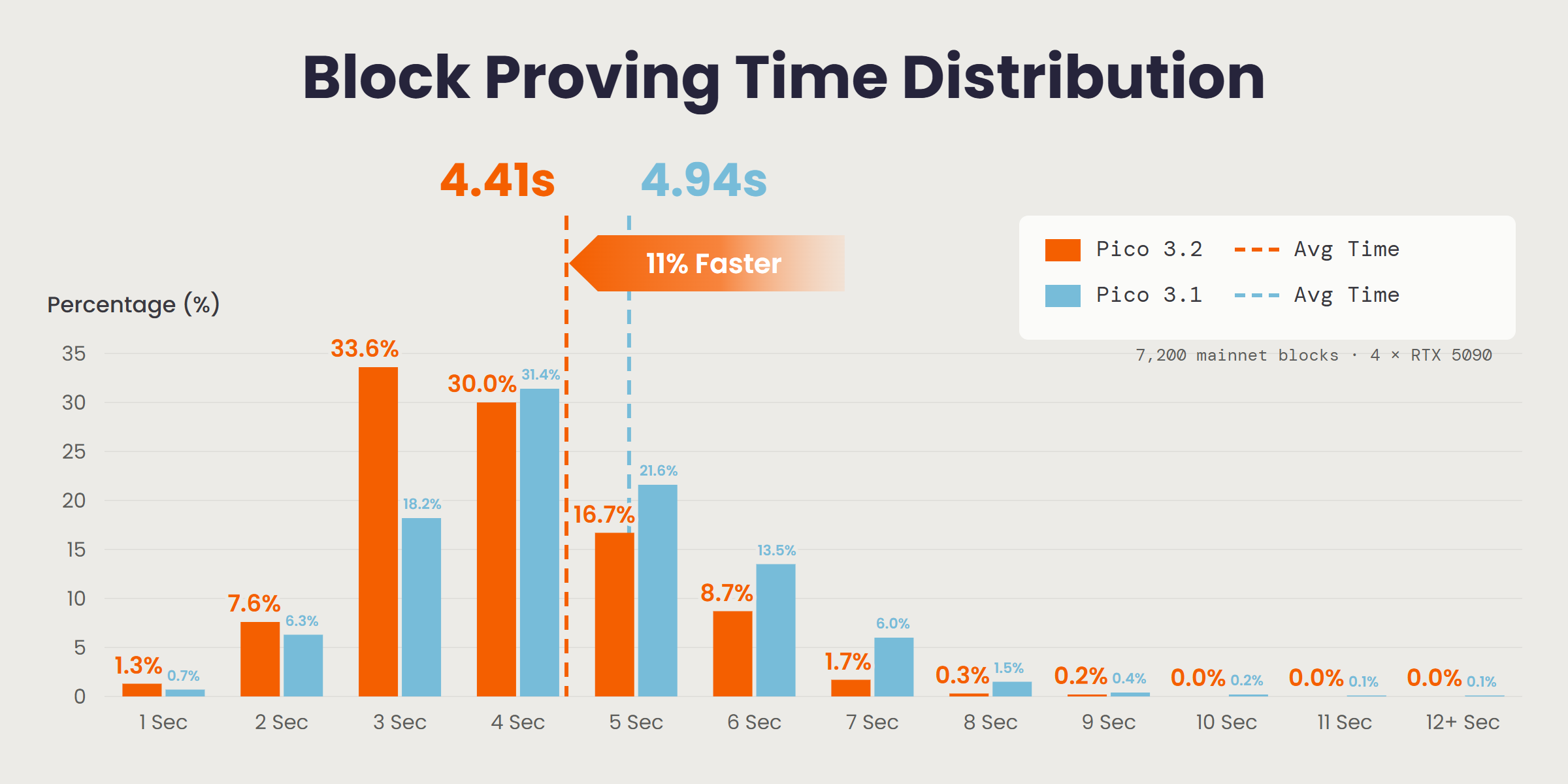
We benchmarked Pico 3.2 across 7,200 consecutive Ethereum mainnet blocks on a single machine equipped with four NVIDIA RTX 5090 GPUs.
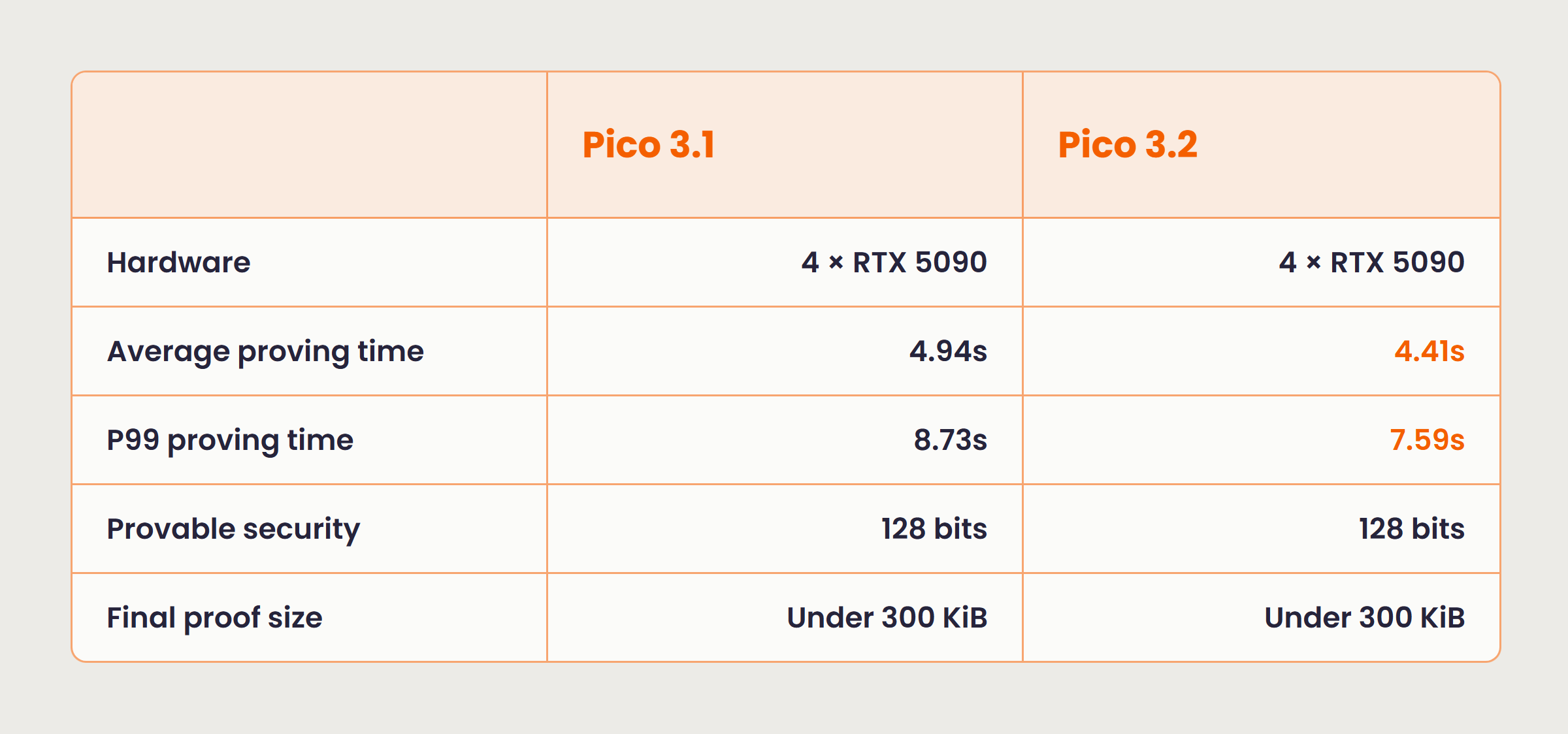
Compared to Pico 3.1, the latest release delivers approximately 13% lower P99 proving latency and 11% lower average proving latency.
These improvements are driven by continued full-stack optimizations:
- More efficient cryptographic circuits, including a redesigned Keccak circuit that reduces its trace cell count per permutation by 57%.
- Faster guest execution, through optimized memory operations, cryptographic accelerators, and improved handling of misaligned memory accesses. Letting guests read and write whole words at misaligned addresses alone leaves 19 to 20% fewer instructions to prove on the EF’s P99 benchmark.
- More efficient GPU proving, through global LogUp, optimized lookup arguments, and reduced memory overhead.
Building the zkVM for Ethereum’s Future
Pico 3.2 still proves Ethereum in real time on four consumer GPUs, now with every EF compliance test passed, formally verified core circuits, and only hash-based cryptography before the final wrapper.
As Ethereum moves closer to integrating ZK proofs into its core protocol, we remain committed to building the proving infrastructure that makes this future possible.
Pico remains fully open source. We welcome developers, researchers, and the broader Ethereum community to explore, verify, and build with us.
About Brevis
Brevis is a verifiable computing platform powered by zero-knowledge proofs, serving as the infinite compute layer for Web3 and beyond. Applications can offload expensive computation off-chain while proving every result on-chain. The Brevis stack includes Pico zkVM for general-purpose computation, which in its 3.2 release proves Ethereum blocks in real time on a single machine with 4 GPUs, passes 100% of the Ethereum Foundation’s zkVM compliance tests, and is fully open source; the ZK Data Coprocessor for trustless access to historical blockchain data; Vera for ZK-proven media authenticity; and ProverNet, the decentralized marketplace for ZK proof generation, live on mainnet. To date, Brevis has generated nearly 400 million proofs across 50+ protocols on 14 blockchains.
Dive Deeper into Brevis:
Website | X | Discord | Pico zkVM | ZK Data Coprocessor | Incentra | ProverNet | Vera | Arca
Interested in building with Brevis? Reach out to us to explore ideas!

