TL;DR: Brevis and Primus have built a Proof-of-Reserves service for Perena, the Solana-based stablecoin protocol behind USD*. Now live, the system combines Primus’s zkTLS and TEE infrastructure with Brevis’s Pico zkVM to verify that USD* reserves, spanning on-chain positions across six Solana protocols, are correctly reported without exposing sensitive account details. Off-chain reserves on Binance and Hyperliquid are planned for the next phase. Every reserve figure is cryptographically proven, continuously updated, and publicly verifiable.
Why Proof of Reserves Still Falls Short
Stablecoin users have been told to “trust, but verify” for years, but the verification part has lagged behind. Most Proof-of-Reserves implementations rely on periodic attestations from third-party auditors, snapshots that are outdated by the time they’re published, or self-reported figures with no cryptographic backing.
The challenge gets harder when reserves are diversified. Perena’s USD* is collateralized by a mix of delta-neutral hedged positions, secured borrow-lend market positions, and real-world assets spread across multiple on-chain protocols and centralized exchanges. Proving reserves for a single wallet on a single chain is straightforward. Proving them across Marginfi, Nest, Glow, Onyc, Prime, and Seedpool on Solana, with future phases covering Binance and Hyperliquid off-chain, requires infrastructure that can aggregate across sources while keeping sensitive data private.
That’s what this collaboration delivers.
How It Works: Three Layers of Verification
Primus and Brevis bring complementary capabilities that map cleanly onto the three stages of reserve verification: data retrieval, secure processing, and verifiable computation.
zkTLS – Authentic Data from Every Source
Reserve data lives in many places. On-chain balances sit in Solana smart contracts. Off-chain balances sit behind authenticated API endpoints at centralized exchanges. The first problem is proving that the data being reported actually came from these sources and wasn’t fabricated.
Primus’s zkTLS solves this by generating a zero-knowledge proof that data was retrieved over a genuine TLS session with the legitimate API endpoint. When the system queries a CEX account balance, zkTLS proves the response came from that exchange’s servers, over an authenticated connection, without exposing API keys or raw account details. The data is real, and the proof says so.
TEE – Secure Processing
Retrieved data passes through a Trusted Execution Environment before reaching the proving network. The TEE ensures confidentiality during processing, so that raw balances and position details are never exposed in transit. It also establishes a secure channel between the data retrieval layer and the proving layer, preventing any intermediary from observing or tampering with the values before they’re committed for verification.
Pico zkVM – Verifiable Aggregation
This is where individual data points become a single, provable reserve figure. Through the TEE’s secure channel, committed balance data from all sources flows into Pico zkVM for aggregation and final computation. Pico generates a zero-knowledge proof that guarantees the disclosed reserve total is correctly derived from the authentic underlying balances.
The math is verifiable and the inputs stay private. The result: a reserve figure that anyone can trust because the proof confirms it was computed correctly from real data, without requiring access to the underlying accounts.
What Perena Gets: Continuous, Verifiable Transparency
Perena offers USD* as a yield-bearing digital dollar on Solana, collateralized by diversified strategies across DeFi and centralized venues. The value proposition to USD* holders depends on confidence that reserves back the supply. With this integration, that confidence shifts from periodic auditor reports to continuous cryptographic verification.
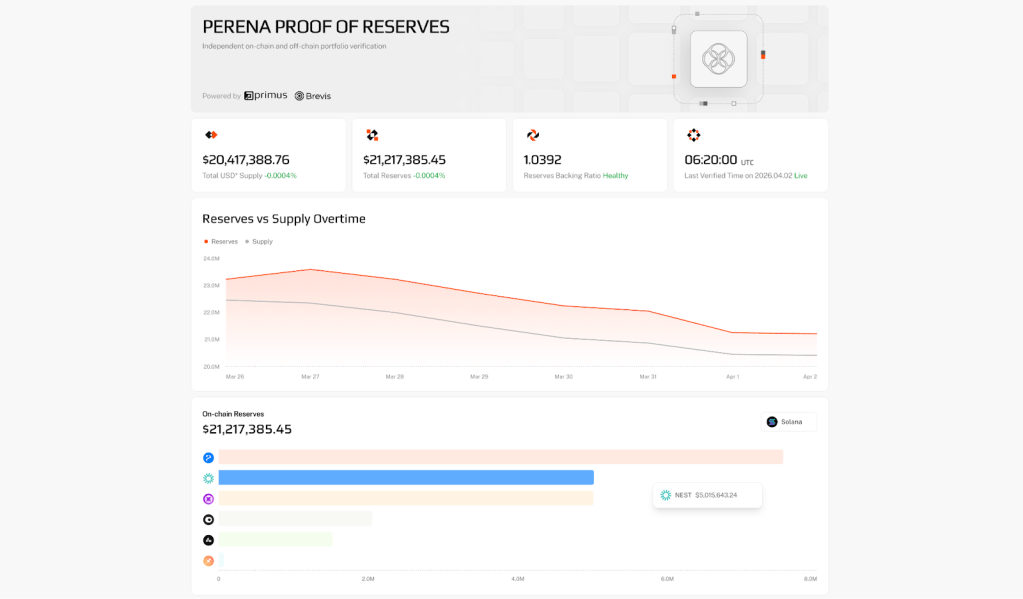
The system is live today, covering on-chain reserves across six Solana protocols: Prime, Nest, Glow, Onyc, Marginfi, and Seedpool. A public explorer page displays verified reserve totals, supply figures, and the reserves-to-supply backing ratio, all updated automatically. Future phases will extend coverage to off-chain reserves on Binance and Hyperliquid, bringing the same zkTLS-verified transparency to centralized exchange holdings.
A reserves backing ratio above 1.0 means USD* is overcollateralized. The proof infrastructure ensures that number is derived from real, authenticated data across every source, not self-reported.
A Composable Standard for Reserve Transparency
The architecture Primus and Brevis have deployed here extends beyond any single stablecoin. Any protocol that holds reserves across multiple on-chain and off-chain venues faces the same verification challenge: aggregating balances from diverse sources, preserving confidentiality, and producing a result that anyone can independently verify.
ZkTLS handles data authenticity, TEE handles secure processing, and Pico zkVM handles verifiable computation. Together, they form a general-purpose Proof-of-Reserves stack that works regardless of where the reserves sit.
About Brevis
Brevis is a verifiable computing platform powered by zero-knowledge proofs, serving as the infinite compute layer for Web3. Applications can offload expensive computations off-chain while proving every result on-chain. The Brevis stack includes Pico zkVM for general-purpose computation, the ZK Data Coprocessor for trustless access to historical blockchain data, Pico Prism for real-time Ethereum block proving (99.6% coverage, 6.9s average), and ProverNet, a decentralized marketplace for ZK proof generation. To date, Brevis has generated hundreds of millions of proofs across 40+ protocols on 6 blockchains.
Dive Deeper into Brevis:
Website | X | Discord | Pico zkVM | ZK Data Coprocessor | Incentra | ProverNet
Interested in building with Brevis? Reach out to us to explore ideas!
 Brevis Network© 2023