
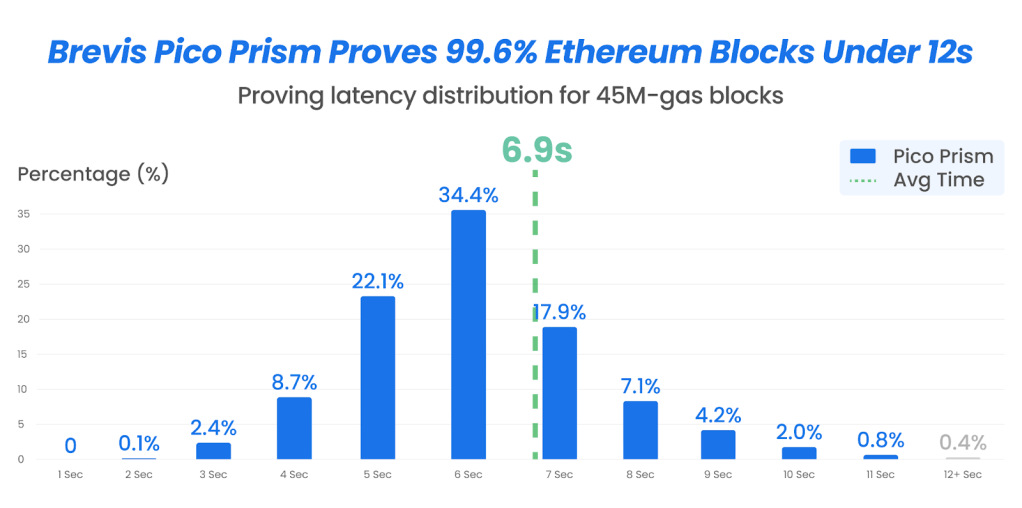
TL;DR: Brevis has achieved real-time proving (RTP) of Ethereum L1 using consumer-grade hardware with 64 RTX 5090 GPUs.Of all EVM blocks produced on Sep 1, 99.6% were proven under 12sec. Moreover, 96.8% were proven under 10sec (the Ethereum Foundation’s real-time proving standard). Average proving time was just 6.9sec with the 45M gas limit.
For direct comparison with previous state-of-the-art, we benchmarked Pico Prism on the same 36M gas limit blocks used in the SP1’s Hypercube RTP announcement. The results show 3.4x better performance efficiency: 98.9% vs. 40.9% of blocks proven under 10sec, 6.04sec vs. 10.3sec average proving time, and $128K vs. $256K GPU costs.
The race to real-time Ethereum proving has been the defining challenge of the zkVM space. For the past two years, teams have been grinding toward an ultimate goal: prove 99% of Ethereum blocks under 10sec with reasonable hardware costs.
The technical hurdles are vast, given that Ethereum blocks contain complex smart contract execution, cryptographic operations, and state transitions that must be proven with mathematical certainty. What takes validators seconds to re-execute takes zkVMs orders of magnitude more computation to prove cryptographically.
Previous State of the Art
The Ethereum community has been working to snarkify the L1 EVM, with clear goals outlined in the EF’s July 2025 roadmap: 99% coverage, sub-10sec proving, hardware capex under $100K, as well as sub-10kW power draw for on-prem proving.
So far, the state of the art has been Succinct’s SP1 Hypercube, which achieved 40.9% real-time proving coverage (<10sec latency) for 36M gas limit blocks. This was done using 160 GPUs, roughly $256K of hardware capex.
Ethereum L1 has since increased its gas limit to 45M gas. Pico Prism has been able to prove bigger blocks with significantly fewer GPUs and significantly lower latency.
Breaking Through Barriers
Pico Prism becomes the first to achieve real-time proving for 45M gas limit blocks using cost-effective consumer hardware. We benchmarked Pico Prism on 8 servers with 8 RTX 5090 GPUs each, totaling 64 GPUs. For comparison with SP1 Hypercube, we uniformly sampled 1,000 blocks from the same time period that Succinct benchmarked on. For 45M gas blocks, we benchmarked every block produced on Sep 1, 2025.
The numbers:
| Metric | SP1 Hypercube | Pico Prism | Improvement |
|---|---|---|---|
| RTP (<10s) coverage (36M gas limit) | 40.9% | 98.9% | 2.4x higher coverage |
| RTP (<10s) coverage (45M gas limit) | N/A | 96.8% | First to achieve |
| GPU cost (MSRP-based) | $256K | $128K | 50% Reduction |
| Average proving time | 10.3sec | 6.04sec | 71% Faster |
| GPU requirements | 160x 4090s | 64x 5090s | Fewer GPUs |
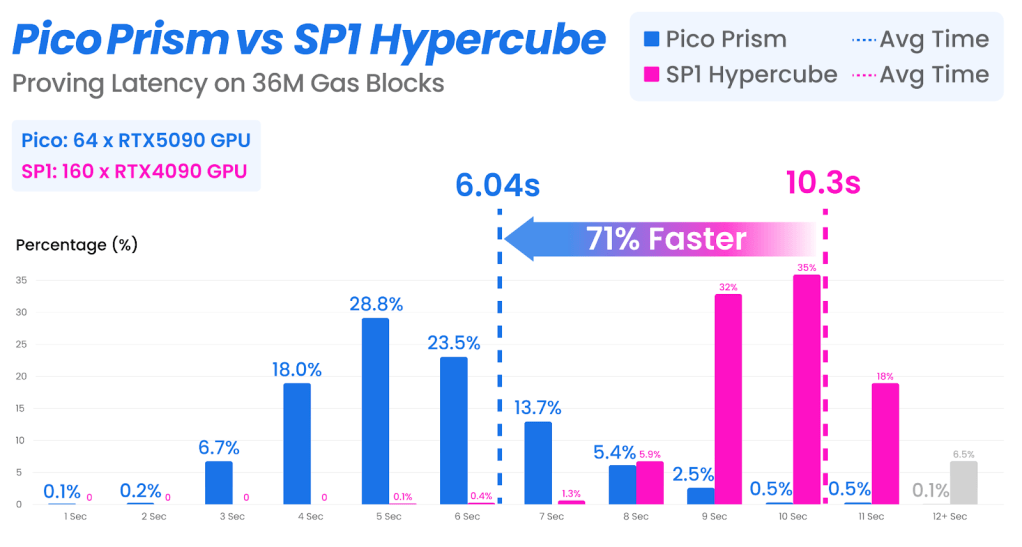
Beyond individual metrics, Pico Prism delivers a 3.4x performance advantage compared to SP1 when combining speed and cost efficiency (evaluated by average proving time × hardware cost).
Using consumer-grade RTX 5090 GPUs, Pico Prism demonstrates that real-time proving can be achieved without requiring expensive data center hardware.
Our benchmark is fully reproducible, and we welcome interested parties to replicate our experiment results. The binaries are available at: https://github.com/brevis-network/pico-ethproofs
Multi-GPU and Multi-machine Proving
Moving from a single-machine, single-GPU prover to a fully distributed multi-machine, multi-GPU architecture is the primary breakthrough. At the heart of this leap is a complete redesign of the computational pipeline.
Thanks to Pico’s modular design, the proving process is decomposed into multiple phases, from emulation to layered recursion. Computation-heavy workloads have been shifted onto GPUs while setup tasks remain on CPUs, executed in embarrassingly parallel pipelines that keep GPUs saturated and operating at maximum efficiency. This extreme optimization and parallelization deliver near-linear acceleration when scaling across a multi-machine, multi-GPU setup, and the result is transformative and undeniable: Pico Prism achieves true real-time proving at Ethereum scale using accessible, consumer-grade hardware.
What’s Next?
With the launch of Pico Prism, the path to Ethereum L1 zkVM integration became significantly clearer. While we are still just 2.2% away from the updated sub-10s real-time proving goal, we are already in the process of rolling out some low-hanging-fruit new features to cross that bar easily.
The next big milestone for Pico Prism is to focus on reducing the cost of proving. We have a roadmap to achieve 99% real-time proving with fewer than 16 RTX 5090 GPUs in the next couple of months.
The path to real-time proving has been a collaborative effort across the ecosystem, with clear technical benchmarks and transparent competition driving rapid innovation. The Ethereum community’s roadmap work and the Ethproofs team’s commitment to open benchmarking created the framework that made breakthroughs like Pico Prism possible. This represents the collective progress of principled technical development and coordination working at scale. We are committed to contributing to an open and reproducible benchmark initiative to further Ethereum’s commitment to transparency and technical excellence.
About Brevis
Brevis is a verifiable computing platform powered by zero-knowledge proofs, serving as the infinite compute layer for Web3. Applications can offload expensive computations off-chain while proving every result on-chain. The Brevis stack includes Pico zkVM for general-purpose computation, the ZK Data Coprocessor for trustless access to historical blockchain data, Pico Prism for real-time Ethereum block proving (99.6% coverage, 6.9s average), and ProverNet, a decentralized marketplace for ZK proof generation. To date, Brevis has generated hundreds of millions of proofs across 40+ protocols on 6 blockchains.
Dive Deeper into Brevis:
Website | X | Discord | Pico zkVM | ZK Data Coprocessor | Incentra | ProverNet
Interested in building with Brevis? Reach out to us to explore ideas!
 Brevis Network© 2023