
TL;DR
QuickSwap, powered by Brevis’s ZK Data Coprocessor, is transforming the DEX trading experience with dynamic fee hooks. These hooks enable real-time fee adjustments to improve LP profitability and incentivize high-volume traders, solving long-standing challenges like impermanent loss and trader retention.
Why do Dynamic Fee Hooks Matter to a DEX User Experience?
QuickSwap is a leading AMM DEX operating across several EVM networks, including Polygon PoS, Ethereum, and Soneium. Using the liquidity pool model, QuickSwap allows Liquidity Providers (LPs) to deposit token pairs into pools, earning transaction fees as traders swap tokens within these pools. However, in the QuickSwap v3 ecosystem, both LPs and traders have faced limitations due to fixed fee tiers.
With the introduction of hooks, this is about to change.
Hooks are smart contracts that enable custom logic to be executed at various stages, such as before or after swaps, during liquidity updates, or at pool creation. This modular architecture introduces flexibility and adaptability to DEXes. They operate as modular tools, applicable across multiple trading pairs, enabling innovative features like dynamic fees. These fees can vary continuously and be adjusted in real-time, down to the block or transaction level.
Since the launch of v3 pools, the profitability of LPs and the retention of loyal traders have been widely discussed issues. LPs are exposed to risks such as impermanent loss and Loss Versus Rebalancing (LVR), which can undermine their profitability. Additionally, the lack of loyalty programs for high-volume traders has restricted the platform’s ability to attract and retain these key users, limiting revenue growth and overall competitiveness compared to centralized exchanges.
With the introduction of dynamic fee hooks, this is about to change.
Dynamic fee hooks provide a powerful solution to these challenges by introducing real-time adaptability into DEXes’ fee structures. These hooks allow fees to be customized on a per-transaction basis or adjusted continuously based on market conditions. For instance, fees can be increased during periods of high volatility to protect LPs from impermanent loss or decreased during high trading volumes to encourage more trades. In this way, dynamic fees enhance LP profitability and attract more trades, ensuring greater capital inflow into pools.
Bringing Dynamic Fee Hooks to QuickSwap and Transforming DEX Trading on Soneium
QuickSwap has taken a significant step forward by introducing dynamic fee hooks in its architecture. Built on the Brevis ZK Data Coprocessor, QuickSwap and Brevis are well-positioned to redefine the DEX trading experience by making it more adaptive, efficient, and profitable for both LPs and traders—all while maintaining complete decentralization and trustlessness.
The first of these innovative hooks—the trading-volume-based dynamic fees hook—has already been implemented in the following select QuickSwap pools on the Soneium, an Ethereum layer 2 built by Sony Block Solutions Labs:
- WBTC/WETH pool: 0x88deb61d597bf26b643293570f5952e2adc01157
- USDC/WETH pool: 0x4E13C7FD28fe96fa5992E7df7D882358629de03A
- USDC/ASTAR pool: 0xF345dA8c68d433E945b685610e12DC570cc0E40E
- ASTAR/WETH pool: 0x4032e4DF76cb2AF20e2aB2c525505799ee30004F
The trading-volume-based dynamic fees hook operates as a BeforeSwap hook. Before executing a swap in a QuickSwap pool, traders are assigned to different VIP tiers based on the sum of their past 30-days of trades and can enjoy discounted swap fees according to their tier. Leveraging the Brevis ZK Data Coprocessor, QuickSwap’s smart contract now computes users’ trading volumes off-chain using historical on-chain event data from previous trades. Each computation is accompanied by a ZK Proof, which verifies both the correctness of the input data and the computation itself, and is then validated on-chain through QuickSwap’s smart contract without requiring additional third-party trust. Once their trading volume and VIP status are verified, the corresponding fee discount will be applied to the trader while trading within the pool for the next month.
The introduction of volume-based dynamic fees in QuickSwap effectively addresses the lack of trader loyalty programs in DEXes by incentivizing high-volume traders, thereby boosting revenue for QuickSwap.
Introducing an Easy-to-Use Portal to Simply Deploy Brevis-Powered Hooks
As previously explained, a hook is an externally deployed contract with the custom logic. When users set up liquidity pools on QuickSwap, they can choose to deploy a hook contract and link a hook with the pool. To simplify the hooks deployment, we are excited to introduce the Brevis Portal—an easy-to-use UI designed to streamline the creation and deployment of hooks while setting up liquidity pools on QuickSwap. Using the Brevis Portal, pool deployers can configure and launch hooks in just a few simple steps by providing the following parameters:
- DEX: The target DEX (QuickSwap)
- Pool Token Details: Symbols and addresses for Token 0 and Token 1
*The address of Token 0 should be smaller than that of Token 1. - Deployed Chain: The network that the hook contract should be deployed
- Pool Address: The address of the liquidity pool
*Before configuring a hook, the pool deployer needs to first deploy the pool and have the pool address in hand. The pool deployer is responsible for making sure the entered pool address is 100% accurate. The pool address cannot be modified after hook creation. - Pool Base Fee Rate: Initial fee rate for the liquidity pool
- Metrics for VIP Categorization: Fixed to [Last 30 days trading volume] by default
*Only “Last 30 day trading volume” can be selected for now, meaning that Brevis only counts the user’s trading volume in the deployed pool in the last 30 days from the moment when the user’s VIP status is activated. - VIP Tier Active Duration: Specifies how long the VIP tier remains active
*The VIP tier active duration is fixed to 30 days for now, meaning that the VIP status will expire after 30 days. - VIP Tier Configuration: Includes tier name, tier icon URL, fee discount percentage, and trading volume requirements for each tier
*The trading volume threshold is denominated in Token 0 of the pool.
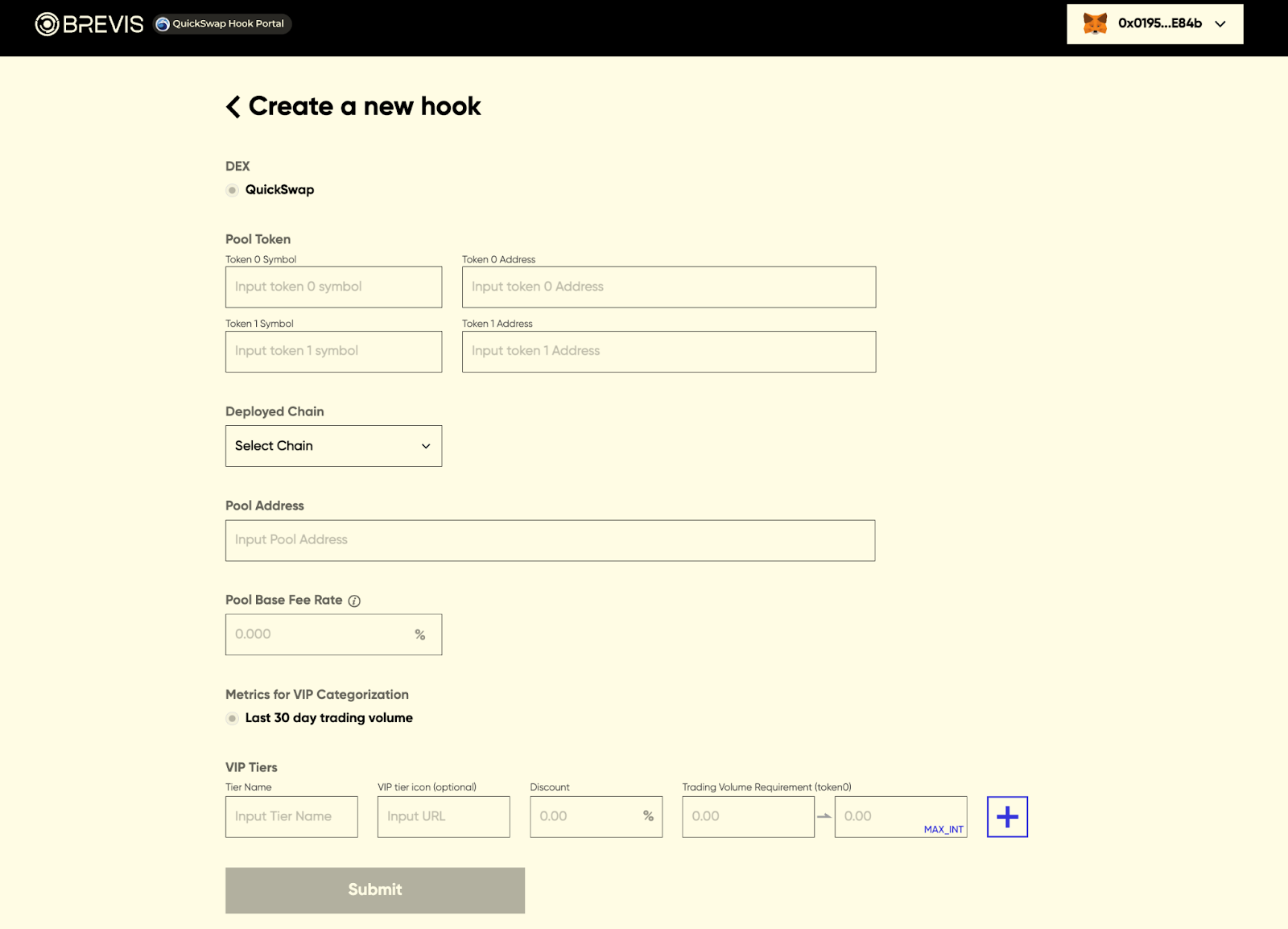
Once all the fields are completed, developers can submit the form to create the hook. After the hook is created, the pool deployer needs to update the plugin address of the pool to the newly deployed hook address by calling the setPlugin interface of the pool contract.
The Brevis Portal also allows pool deployers to view a list of hooks they have created. The list provides detailed configurations for each hook, along with the hook contract address and the current hook creation status.

Looking Ahead and Other Dynamic Fees Hook Options
The integration of dynamic fee hooks is set to enhance QuickSwap’s adaptability and profitability. While the trading-volume-based dynamic fees hook is a strong starting point, the potential for QuickSwap and Brevis collaboration doesn’t stop there—the following dynamic fees hook options are also in the pipeline and will be released soon:
- Token-holding-based dynamic fees
The token holding-based dynamic fees hook is a feature designed to reward long-term and substantial token holders by offering them reduced trading fees. These holders are often key contributors to the project. By incentivizing these users with trading discounts, projects can encourage long-term commitment from these OG holders. Brevis would empower the proof generation of the holders’ time weighted average of token holding balance and feed the verified data to QuickSwap’s smart contract to trigger the trading fee discount.
- Volatility-based dynamic fees
Trading-volume-based dynamic fees are designed to reward traders for their ongoing loyalty, while volatility-based dynamic fees aim to protect liquidity providers LPs from LVR—compensating LPs for potential losses by ensuring they earn higher fees during volatile conditions. The Brevis-powered volatility-based dynamic fees hook leverage ZK proofs to assess market volatility in near real-time, using historical on-chain data to dynamically adjust trading fees during periods of high market volatility.
Brevis and QuickSwap are both dedicated to exploring these opportunities and bringing these innovative dynamic fees to QuickSwap, advancing the user experience for QuickSwap’s traders and LPs.
About QuickSwap
QuickSwap is a DEX and AMM built on Soneium, Polygon, and other EVM chains, offering a complete DeFi suite consisting of swaps, liquidity providing, farms, decentralised perpetual trading, staking, and more.
About Brevis
Brevis is a verifiable computing platform powered by zero-knowledge proofs, serving as the infinite compute layer for Web3. Applications can offload expensive computations off-chain while proving every result on-chain. The Brevis stack includes Pico zkVM for general-purpose computation, the ZK Data Coprocessor for trustless access to historical blockchain data, Pico Prism for real-time Ethereum block proving (99.6% coverage, 6.9s average), and ProverNet, a decentralized marketplace for ZK proof generation. To date, Brevis has generated hundreds of millions of proofs across 40+ protocols on 6 blockchains.
Dive Deeper into Brevis:
Website | X | Discord | Pico zkVM | ZK Data Coprocessor | Incentra | ProverNet
Interested in building with Brevis? Reach out to us to explore ideas!
 Brevis Network© 2023