
We’re thrilled to unveil Pico-GPU 1.0—our groundbreaking GPU-accelerated version of the Pico zkVM. Pico-GPU delivers end-to-end acceleration of zkVM proving and sets a new standard for zkVM performance. While Pico is already the fastest zkVM on CPU, its GPU version gives another 10×~20× performance boost, making it the fastest zkVM on both hardwares. Pico-GPU is now live on Ethproofs, actively proving full Ethereum block executions. From Block #22,783,600 to #22,788,500, Pico-GPU has demonstrated an average of a 25% performance increase over Succinct’s SP1 zkVM on a single-GPU setup. We plan to release Pico-GPU 2.0 soon, featuring highly optimized multi-server clustering capabilities to enable distributed proving at scale.
Built for Speed: 10× Faster, Setting the New Standard
Table 1
Comparing Pico-GPU and Pico-CPU
| Pico | CPU | GPU | Acceleration (x) |
|---|---|---|---|
| Tendermint | 122s | 15s | 8.1 |
| Reth-17106222 | 1382s | 74s | 18.7 |
| Reth-20528709 | 2173s | 119s | 18.3 |
Four months ago, we introduced Pico, a modular and industry-leading zkVM optimized for CPU execution. Its performance and flexibility stem from its modular architecture, which empowers developers to tailor proving backends and workflows with ease. Pico also has taken the “glue-and-coprocessor” architecture to a whole new level, enabling seamless integration of both function-level precompiles and app-level enshrined ZK infrastructure. With Pico’s modular foundation, we managed to port the entire zkVM stack to GPU in just a few months.
To see the performance gains from GPU acceleration, we reran previously established benchmarks—Tendermint, Reth block 17106222, and Reth block 20528709—on a test machine equipped with 64 vCPU cores (AMD EPYC 9354) and a single GPU (NVIDIA GeForce RTX 4090) with 462 GB of memory. While the Pico-CPU version utilizes all CPU cores, the Pico-GPU variant harnesses both CPU and GPU resources. As illustrated in Table 1, Pico-GPU delivers nearly 10× speedup on medium-sized workloads like Tendermint, and up to 20× acceleration on large-scale workloads like Reth blocks.
Table 2
Pico-GPU vs other zkVMs
| Task | zkVM | Hardware | Runtime (s) | Acceleration (x) |
|---|---|---|---|---|
| Tendermint | OpenVM | CPU | 376 | 25.1 |
| RISC0 | GPU | 210 | 14 | |
| SP1 | GPU | 17 | 1.1 | |
| Pico | GPU | 15 | 1 | |
| Reth-17106222 | OpenVM | CPU | 687 | 9.3 |
| RISC0 | GPU | 1203 | 16.3 | |
| SP1 | GPU | 96 | 1.3 | |
| Pico | GPU | 74 | 1 | |
| Reth-20528709 | OpenVM | CPU | 959 | 8.1 |
| RISC0 | GPU | 2075 | 17.4 | |
| SP1 | GPU | 152 | 1.3 | |
| Pico | GPU | 119 | 1 |
We also benchmarked Pico-GPU against other leading zkVM implementations, including SP1 (GPU), RISC0 (GPU), and OpenVM (CPU, as OpenVM currently lacks GPU support), using the same hardware and workloads. As shown in Table 2, Pico-GPU consistently outperforms all competitors, setting a new benchmark for GPU-based zkVM proving performances.
Real-World Use Cases, Live Today
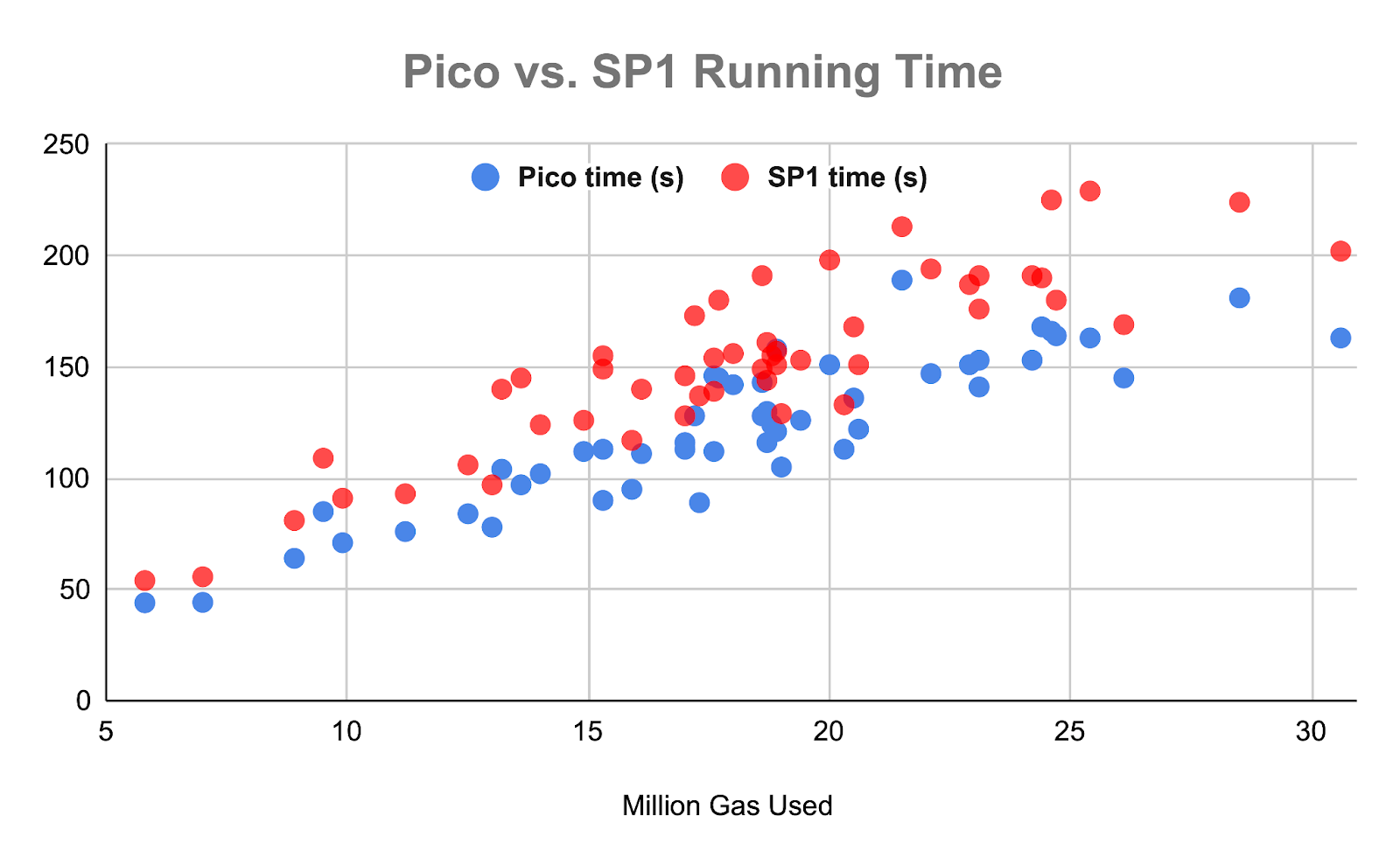
Pico-GPU is live today. Fully integrated into Ethproofs, it now proves every 100th Ethereum block, reliably executing under real-world conditions. For benchmarking purposes, we selected 50 Ethereum blocks ranging from #22,783,600 to #22,788,500 and analyzed the proving times across various zkVMs. Pico-GPU consistently demonstrated the overall best performance. In particular, it outperformed Succinct’s SP1 by an average of 25% with a single NVIDIA GeForce RTX 4090 GPU setup.
We’re also migrating key partner workloads to Pico-GPU, including:
- Reward and revenue distribution for Usual and several upcoming stablecoin partners
- Verifiable smart hooks for PancakeSwap, Thena, and QuickSwap
- A trustless DeFi incentive distribution platform
- A ZK-powered privacy-preserving perpetual swap protocol, launching soon
By offloading complex logic to a GPU-accelerated zkVM, these integrations enable efficient, verifiable, and modular execution for real-world applications.
What’s Next
- Cluster optimizations: Enhancements to support scalable, cross-server execution
- Extended coprocessors: Including high-performance modules for AI inference and other domains
- Refined benchmarks and tooling: Detailed performance reports and integration guides coming soon
Join us in redefining how dApps are built and scaled—Pico-GPU is unlocking a new era in zero-knowledge computing.
About Brevis
Brevis is a verifiable computing platform powered by zero-knowledge proofs, serving as the infinite compute layer for Web3. Applications can offload expensive computations off-chain while proving every result on-chain. The Brevis stack includes Pico zkVM for general-purpose computation, the ZK Data Coprocessor for trustless access to historical blockchain data, Pico Prism for real-time Ethereum block proving (99.6% coverage, 6.9s average), and ProverNet, a decentralized marketplace for ZK proof generation. To date, Brevis has generated hundreds of millions of proofs across 40+ protocols on 6 blockchains.
Dive Deeper into Brevis:
Website | X | Discord | Pico zkVM | ZK Data Coprocessor | Incentra | ProverNet
Interested in building with Brevis? Reach out to us to explore ideas!
 Brevis Network© 2023