TL;DR
Usual and Brevis have worked closely together to revolutionize token distribution with the introduction of the Continuous Protocol Incentivization (CPI) program. We are thrilled to announce its official launch now on Mainnet! The CPI program is designed to reward users who actively contribute to Usual’s stablecoin ecosystem. Eligible users who hold or provide liquidity for USD0 and USD0++ across multiple DeFi platforms integrated with Usual can trustlessly claim their USUAL rewards, verified by ZK Proofs generated by Brevis.
An Overview of Continuous Protocol Incentivization (CPI)
The Continuous Protocol Incentivization program is designed to reward users for their ongoing, genuine engagement within Usual’s stable token ecosystem.
CPI was introduced to overcome the shortcomings of token airdrops and align the interests of both projects and communities for long-term success. CPI leverages the Brevis ZK Data Coprocessor to continuously track users’ on-chain activities within Usual’s stablecoin ecosystem and distribute USUAL tokens based on attested activities verified by ZK Proofs (ZKPs). This new ZK-powered token distribution program offers several key benefits:
- Incentives Aligned for Long-Term Growth: Continuous Protocol Incentivization drives post-launch growth by continuously distributing tokens based on users’ ongoing engagement with the protocol, rather than only rewarding pre-launch activities.
- Verifiable and Trust-free: Continuous Protocol Incentivization leverages the Brevis ZK Data Coprocessor to generate ZKPs attesting to users’ on-chain activity and interactions. This approach ensures users can independently verify reward logic and data integrity without needing to rely on hidden processes, addressing concerns around fairness, transparency, and accountability.
- Scalable and Low-cost: Performing direct on-chain data computation and access using the latest blockheader through iterative Merkle Tree inclusion proofs and RLP data deserialization would result in astronomical costs and latency, making it impractical. Brevis enables high scalability and cost-effectiveness for CPI by migrating the complex computation and corresponding ZK proving process to an ultra-low-cost, parallel off-chain computing environment.
- Transparent and Adjustable Rules: The CPI rules are fully transparent and can be adjusted through a project’s on-chain governance process, providing DAOs with the flexibility to evolve the program as needed.
- Support for Flexible Distribution Logic: Brevis’s programmable SDK enables smart contracts to access various on-chain data (such as storage states, events, and transactions) and perform custom computations. This flexibility allows CPI to support a wide range of eligibility and reward criteria—like token balances, transfers, liquidity provision, governance participation, and more—without requiring changes to existing smart contracts.
CPI Goes Live: Powering USUAL Rewards on Mainnet
Usual is a secure and decentralized fiat stablecoin issuer that redistributes ownership and governance through the USUAL token. There are two core products in the Usual stablecoin ecosystem:
- USD0: a Real-World Assets (RWA) backed stablecoin
- USD0++: an enhanced, 4-year DeFi T-Bill secured by locked USD0
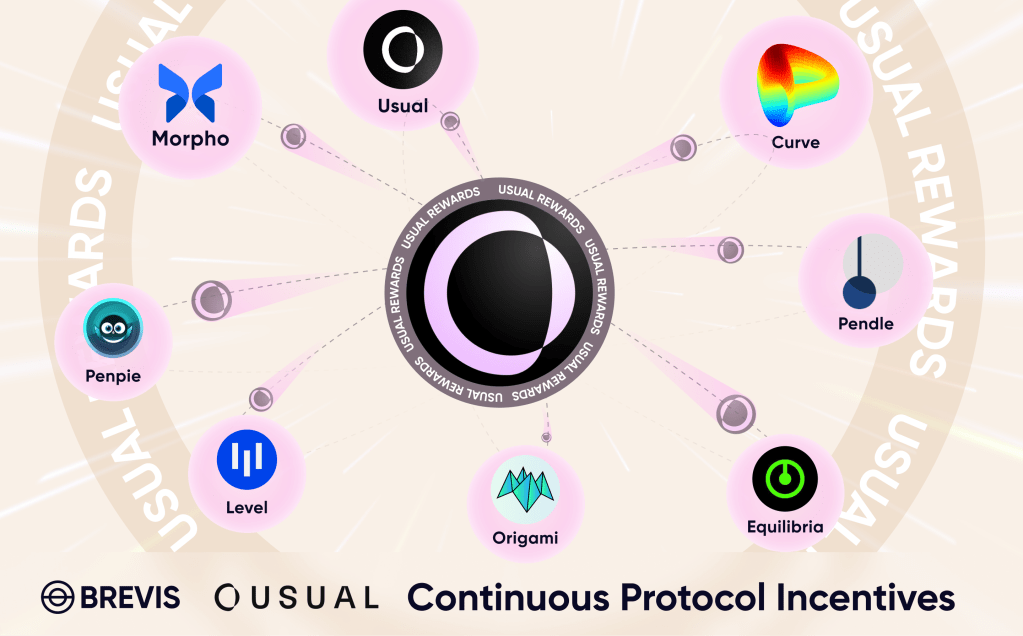
With Usual now integrated into several leading DeFi protocols including—Curve, Pendle, Morpho, Origami, Level, Penpie, and Equilibria, users have an exceptional opportunity to unlock the unique advantages of USD0++ and USD0 while maximizing their rewards. Users who actively participate in and provide liquidity to USD0 and USD0++ on these platforms can earn rewards in the form of USUAL tokens.
Here’s exactly how the rewards distribution works:
Daily Rewards Distribution to Usual USD0++ Holders
Usual will distribute daily rewards to USD0++ holders based on their USD0++ position holdings on Ethereum and Arbitrum.
Daily Rewards Distribution to Curve LPs
Usual will distribute daily rewards to Curve USD0/USD0++ LPs and USD0/USDC LPs based on their position holdings on Ethereum mainnet. If an LP token is transferred, the new holder will receive the USUAL distribution.
Daily Rewards Distribution to Pendle LPs and YT Holders
Usual will distribute daily rewards to Pendle USD0++ LPs and USD0++ YT holders on Ethereum mainnet. If an LP token or YT token is transferred, the new holder will receive the USUAL distribution.
Daily Rewards Distribution to Morpho Depositors
Usual will distribute daily rewards to Morpho suppliers who deposit USD0++ as collateral and optionally borrow USDC based on their collateral amount on Ethereum mainnet. In case of liquidation, the USD0++ collateral will be credited to the liquidator and the rewards will also be accumulated to the liquidator.
Daily Rewards Distribution to Origami LPs
Usual will distribute daily rewards to LPs who deposit USD0++ into the Origami vault (i.e., holders of lov-USD0++ tokens) based on their position holdings as well as the leverage ratio of the Origami vault on Ethereum mainnet.
Daily Rewards Distribution to Level Depositors
Usual will distribute daily rewards to Level users who deposit USD0++ to back lvlUSD based on their deposit amount on Ethereum mainnet.
Daily Rewards Distribution to Penpie Depositors
Usual will distribute daily rewards to Penpie depositors who deposit Pendle USD0++ LP token on Ethereum mainnet based on the amount of the USD0++ side of the LP token. When depositing Pendle USD0++ LP tokens into Penpie LP, the user will receive a receipt token. If the receipt token is transferred, the new holder will receive the USUAL distribution.
Daily Rewards Distribution to Equilibria Depositors
Usual will distribute daily rewards to Equilibria depositors who deposit Pendle USD0++ LP token on Ethereum mainnet based on the amount of deposited USD0++ LP tokens. When depositing Pendle USD0++ LP tokens into the Equilibria PendleBooster contract, the user will receive a receipt token. If the receipt token is transferred, the new holder will receive the USUAL distribution.
Brevis will fetch the position data from the platforms mentioned above, calculate the reward amounts for all eligible users, and generate ZK Proofs for the results. These calculations strictly adhere to the rules set by Usual, and the ZKPs serve as cryptographic attestations, providing irrefutable evidence of both the accuracy of the data and the correctness of the calculations to Usual’s smart contracts. The generated ZKPs will be aggregated and submitted to the verifier contract on Arbitrum for verification. Usual’s contract will then distribute USUAL rewards to the eligible users based on the verified results—the entire process is designed to be transparent and trustless as users can independently verify the accuracy of reward amounts based on ZKPs without relying on a centralized authority.
Claiming Rewards and What’s Coming Next
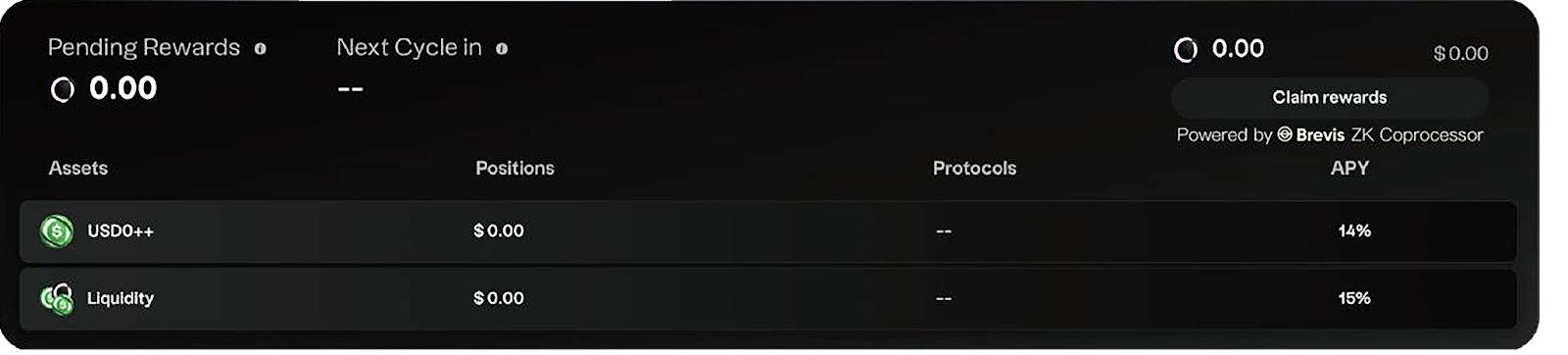
Each eligible user can claim rewards via the Usual dApp with a simplified, single-transaction UX. The latest version of the Brevis ZK Data Coprocessor v2 has significantly improved processing performance and streamlining the user experience.
With this initial launch of the Continuous Protocol Incentivization program on Mainnet, Usual will ensure the consistent distribution of USUAL rewards to the genuine contributors driving liquidity and utility within its stablecoin ecosystem. This is just the beginning, Brevis and Usual are committed to further optimizing the program and integrating additional protocols in the next phase. Stay tuned—exciting updates are coming soon!
About Usual
Usual is a decentralized stablecoin protocol designed to bring transparency, security, and long-term value redistribution to the DeFi ecosystem. By leveraging real-world asset backing, Usual offers USD0, a fully collateralized and resilient stablecoin, providing a reliable alternative to traditional fiat-backed models. At the core of the protocol is USUAL, a governance and rewards token that aligns incentives between users and the ecosystem, distributing yield while granting holders a stake in Usual’s future. Through its innovative approach, Usual empowers its community with both financial rewards and governance participation, ensuring a stable and decentralized foundation for the next generation of on-chain finance.
About Brevis
Brevis is a verifiable computing platform powered by zero-knowledge proofs, serving as the infinite compute layer for Web3. Applications can offload expensive computations off-chain while proving every result on-chain. The Brevis stack includes Pico zkVM for general-purpose computation, the ZK Data Coprocessor for trustless access to historical blockchain data, Pico Prism for real-time Ethereum block proving (99.6% coverage, 6.9s average), and ProverNet, a decentralized marketplace for ZK proof generation. To date, Brevis has generated hundreds of millions of proofs across 40+ protocols on 6 blockchains.
Dive Deeper into Brevis:
Website | X | Discord | Pico zkVM | ZK Data Coprocessor | Incentra | ProverNet
Interested in building with Brevis? Reach out to us to explore ideas!
 Brevis Network© 2023