
TL;DR
Usual Money, a leading stable token ecosystem, introduces an innovative mechanism to drive long-term community growth by ensuring transparent and verifiable revenue redistribution. Users can now stake the USUAL token, obtain USUALx, and claim their share of protocol revenue by using a ZK Proof of token holding statistics generated by the Brevis ZK Data Coprocessor. With Brevis, Usual Money is able to launch a fully decentralized, transparent, and secure revenue distribution feature on mainnet.
Understanding Usual Money Revenue Switch
USUAL serves as the native governance token of the Usual protocol. When users stake their USUAL tokens, they receive USUALx in return, a liquid staked token (LST) that accrues rewards automatically while remaining fully transferable. This staking process transforms USUAL into a yield-generating asset, granting stakers a share in the protocol’s economic growth.
Holding USUALx unlocks multiple revenue streams within the Usual ecosystem:
- Daily USUAL Emissions: USUALx holders receive 10% of all USUAL emissions distributed by the protocol. This allocation ensures that as new USUAL tokens are emitted, a fixed share is directed to USUALx holders, providing continuous rewards for their commitment.
- Protocol Fees: USUALx holders earn a portion of the fees generated within the Usual ecosystem. Specifically, 33.33% of all USUAL-denominated protocol fees—including unstaking fees and early-redemption fees from USD0++—are redistributed to USUALx holders.
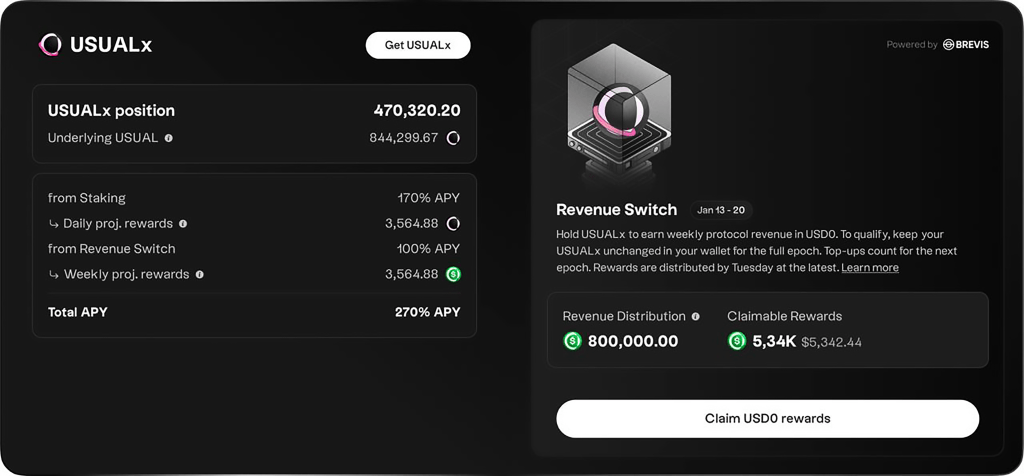
- Revenue Switch Mechanism: The protocol accrues revenue from interest earned on USD0 collateral. Through the Revenue Switch, this revenue is redirected as dividends to USUALx holders, ensuring they benefit directly from the protocol’s financial gains.
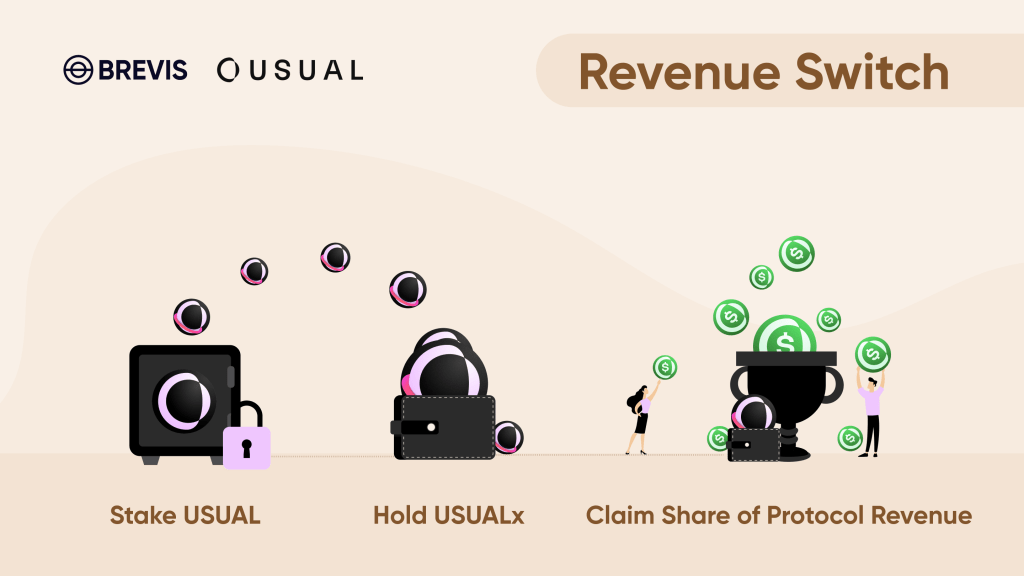
The Revenue Switch is a vital component in Usual’s ecosystem for two reasons. First, it strengthens the long-term value of staking by providing USUALx holders with a predictable and stable revenue stream beyond traditional token emissions. Unlike staking models that rely solely on inflationary rewards, the Revenue Switch ties rewards directly to the protocol’s actual economic performance. Second, it aligns incentives between the protocol and the community; as USD0 adoption and protocol activity grow, USUALx holders see increased rewards.
A Transparent, Decentralized and Secure Revenue Switch
Usual Money has led the charge in building the most transparent, decentralized, and secure stable token ecosystem end-to-end. The Revenue Switch, being a critical component, naturally follows the same vision. However, the transferability of USUALx tokens poses a unique challenge: there is no cost-effective way to access a user’s historical time-weighted average token holdings in a smart contract directly. Although off-chain computing on a centralized server can make the distribution work, it breaks the trust assumptions of Usual as a permissionless protocol and introduces significant security risks.
This is where the Brevis ZK Data Coprocessor comes into play. For each user, Brevis can generate a ZK Proof of their time-weighted average token holdings based on historical blockchain data. This includes block storage slot data that records each user’s USUALx token holdings, as well as all token transfer events during any reward distribution epoch. Brevis then produces ZK Proofs for each individual reward amount, ensuring that the data sources and the computations themselves are accurate and verifiable.
Although all computation and ZK Proof generation happens off-chain, a verifier smart contract uniquely bound to this revenue distribution business logic is deployed on-chain and can easily verify the results. Once verified, rewards are seamlessly distributed to the end users.
With Brevis’s “compute off-chain, verify on-chain” model, Usual Money’s revenue redistribution operates at a much lower cost than direct on-chain computation. At the same time, it remains fully transparent, decentralized, trustless, and as secure as the underlying blockchain, thanks to cryptographically verified ZK Proofs.
About Usual
Usual is a decentralized stablecoin protocol designed to bring transparency, security, and long-term value redistribution to the DeFi ecosystem. By leveraging real-world asset backing, Usual offers USD0, a fully collateralized and resilient stablecoin, providing a reliable alternative to traditional fiat-backed models. At the core of the protocol is USUAL, a governance and rewards token that aligns incentives between users and the ecosystem, distributing yield while granting holders a stake in Usual’s future. Through its innovative approach, Usual empowers its community with both financial rewards and governance participation, ensuring a stable and decentralized foundation for the next generation of on-chain finance.
About Brevis
Brevis is a verifiable computing platform powered by zero-knowledge proofs, serving as the infinite compute layer for Web3. Applications can offload expensive computations off-chain while proving every result on-chain. The Brevis stack includes Pico zkVM for general-purpose computation, the ZK Data Coprocessor for trustless access to historical blockchain data, Pico Prism for real-time Ethereum block proving (99.6% coverage, 6.9s average), and ProverNet, a decentralized marketplace for ZK proof generation. To date, Brevis has generated hundreds of millions of proofs across 40+ protocols on 6 blockchains.
Dive Deeper into Brevis:
Website | X | Discord | Pico zkVM | ZK Data Coprocessor | Incentra | ProverNet
Interested in building with Brevis? Reach out to us to explore ideas!
 Brevis Network© 2023