TL;DR
Brevis is thrilled to announce the partnership with Kernel to launch the “Propose-Challenge” ZK Data Coprocessor model with Kernel on BNB Chain. This innovative model combines the strengths of crypto-economic security with the power of ZK Proofs, offering higher flexibility for dApps to customize the challenge delay and crypto-economic security level and allowing them to choose the best option for their specific use cases.
Intro to Kernel and The Advanced Use Cases Leveraged by Brevis
Kernel is a restaking protocol that offers decentralized and shared security by incentivizing users to stake their BNB directly or via liquid staking tokens (LSTs). As a pioneer in the BNB ecosystem, Kernel extends a robust network of shared security for Dynamic Validator Networks (DVNs) while aiming to maximize the efficiency of staked assets. In return, DVNs offer a wide range of rewards and opportunities for stakers.
Brevis is a powerful smart ZK Data Coprocessor that empowers smart contracts to access and process historical on-chain data from any blockchain, enabling trustless, data-rich computation. Leveraging the immense computational power of Brevis, developers can implement a variety of data-driven features such as:
- VIP loyalty programs based on users’ historical trading volumes, increasing engagement and long-term retention.
- Brevis’s Continuous Protocol Incentivization Program that segments and rewards users based on their ongoing engagement with the protocol, enabling the creation of user-friendly features and personalized experiences tailored to an address’s on-chain activity footprint.
- Automated order execution for active liquidity management protocols by triggering predefined user intents through ZK-verified on-chain states and events.
- Strengthened LVR protection and improved farming reward distribution mechanisms for AMMs.
Revolutionizing ZK Data Coprocessor with the “Propose-Challenge” Model on BNB Chain
The collaboration between Brevis and Kernel marks a significant milestone in the evolution of ZK Data Coprocessing infrastructure—we’ve introduced the “Propose-Challenge” ZK Data Coprocessor model on BNB Chain and will be launching it as a DVN in addition to the “pure-ZK” model.
The Brevis DVN is essentially a Proof-of-Stake (PoS) network that is supported by restaked BNB tokens from Kernel. When Brevis accepts coprocessing requests, instead of generating a ZK Proof for each request, it can generate “optimistic” results through a PoS consensus reached by Kernel’s operators. These results are submitted back to the blockchain as proposals and can then be challenged via a ZK fraud proof. The design includes a system-level challenge window for accepting ZK fraud proofs to rectify any potential invalid results that make it past the application-specified window or challenge period. If no challenge is made, dApps can use the results directly without incurring ZK proof generation costs. This significantly increases the speed of data computation while ensuring the reliability and availability of the results.
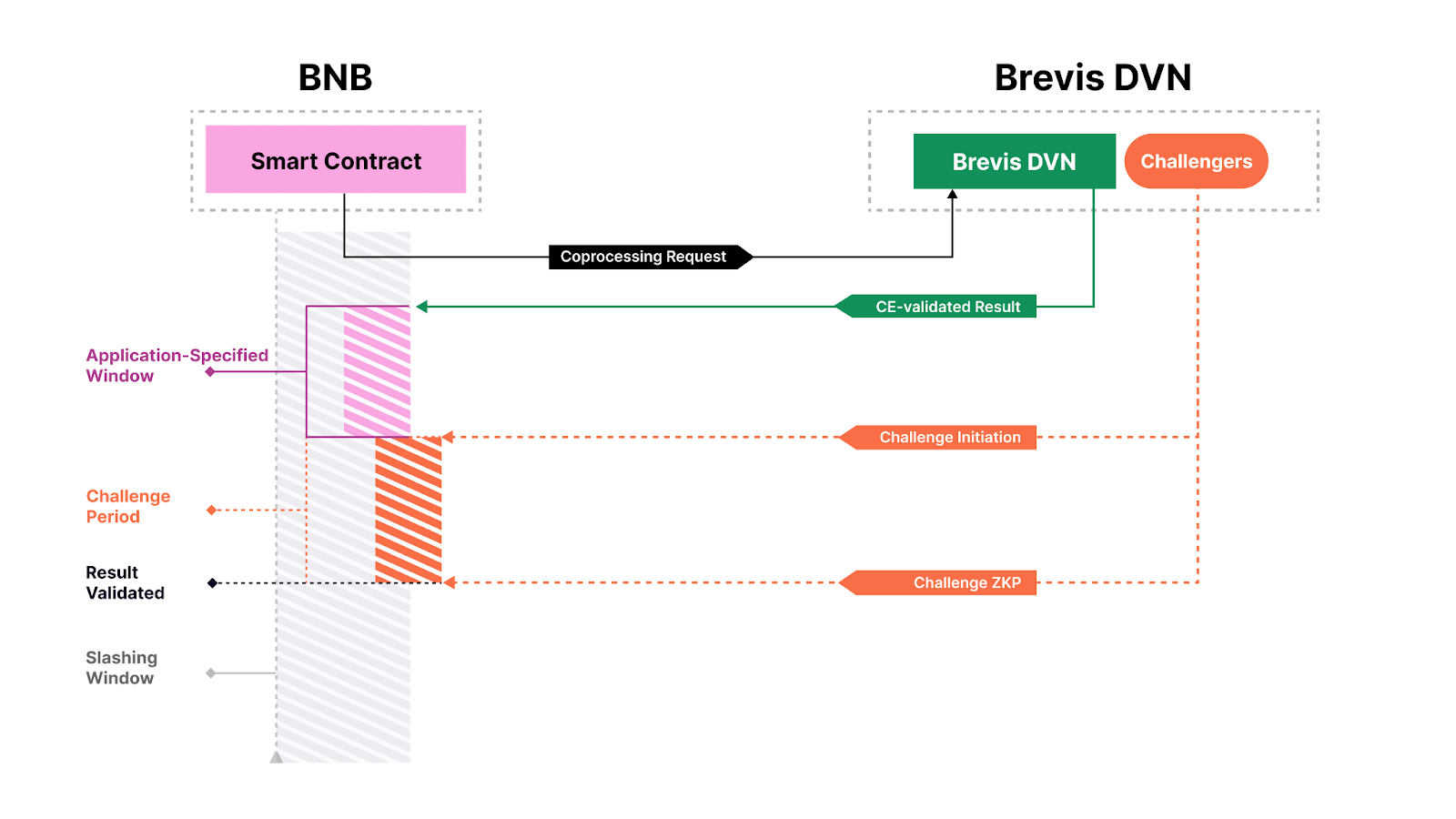
As an option aside from the “Pure-ZK” model, the “Propose-Challenge” ZK Data Coprocessor provides developers with a broader range of options to make tradeoffs between cost efficiency and latency with the same level of ZK security. Developers are able to customize the challenge delay and the crypto-economic security level to suit their specific implementations.
This fusion of crypto-economics and ZK proofs not only ensures the secure and trustless nature of Brevis but also provides higher flexibility for developers to implement according to their specific use cases.
Kernel and Brevis Collaborate to Enable A Wider Range of Data-Intensive Features to BNB Chain
Through this collaboration, we believe the “Propose-Challenge” coprocessing mechanism will empower a wider range of data-intensive use cases on BNB chain, including but not limited to the above-mentioned ones. We anticipate forthcoming announcements regarding exciting new implementations.
From the dApps developer’s perspective, working with and integrating our Brevis ZK Data Coprocessor v2 offers a seamless opt-in experience and requires minimal adjustments through a simple configuration flag while allowing the development and creation of trustless data-driven dApps. Some of the key benefits of v2 include unbounded data access by handling any number and size of historical receipts & transactions in a single request, increased performance via optimized ZK circuits and parallel proving systems and other new features such as access to full block information, and multi-request batching and enhanced data processing APIs. The availability of v2 and the “Propose-Challenge” model make Brevis even more powerful, as the optimized ZK circuits can now achieve over 10x the latency improvements and the “optimistic” coprocessing can substantially lower the cost.
About Kernel
KernelDAO is a top restaking protocol, with over $2 billion total value locked and live on 10+ chains including Ethereum, BNB Chain, Arbitrum, Optimism, and expanding further. KernelDAO’s three key products include Kernel – the restaking infrastructure on the BNB Chain, Kelp LRT – a leading liquid restaking protocol on Ethereum, and Gain – a tokenised rewards program designed for users to maximize their earning potential by accessing highest rewards and top airdrops conveniently. By empowering stakers, developers, and protocols, KernelDAO is committed to driving the next wave of Restaking innovation, creating opportunities for all to participate in emerging technologies, and be the backbone of decentralized economic security.
For more information about $KERNEL and Kernel’s ecosystem, visit https://kerneldao.com/
About Brevis
Brevis is a verifiable computing platform powered by zero-knowledge proofs, serving as the infinite compute layer for Web3. Applications can offload expensive computations off-chain while proving every result on-chain. The Brevis stack includes Pico zkVM for general-purpose computation, the ZK Data Coprocessor for trustless access to historical blockchain data, Pico Prism for real-time Ethereum block proving (99.6% coverage, 6.9s average), and ProverNet, a decentralized marketplace for ZK proof generation. To date, Brevis has generated hundreds of millions of proofs across 40+ protocols on 6 blockchains.
Dive Deeper into Brevis:
Website | X | Discord | Pico zkVM | ZK Data Coprocessor | Incentra | ProverNet
Interested in building with Brevis? Reach out to us to explore ideas!
 Brevis Network© 2023