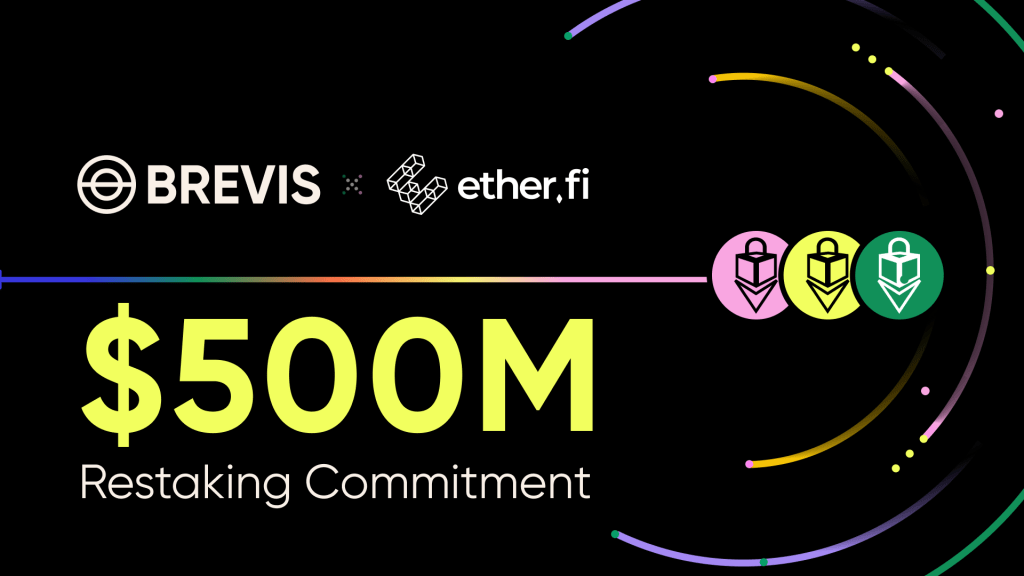
We are thrilled to announce that we’ve finalized an agreement with Ether.fi, the premier Liquid Restaking Protocol, who will be delegating $500M of staked ETH to help secure Brevis coChain Actively Validated Services (AVS) once we complete our integration and launch on Mainnet! This marks an amazing step forward in securing ZK coprocessing infrastructure for Web3!
Liquid Restaking and Ether.fi
Restaking is devised to improve the utility of staked assets. One of the featured restaking protocols is EigenLayer, built on Ethereum, which revolutionizes crypto-economic security by reusing staked ETH or Liquid Staking Tokens (LSTs) for additional infrastructure services or PoS networks, which are referred to as Actively Validated Services (AVSs). Liquid Restaking is the process of allowing stakers to natively stake ETH or deposit liquid staking tokens (LSTs) into smart contracts to participate in restaking to the various AVSs and earn extra yield.
Ether.fi is one of the top decentralized Liquid Restaking protocols. One of the distinguishing characteristics of Ether.fi is that stakers control their keys. The Ether.fi mechanism also allows for the creation of a node services marketplace where stakers and node operators can enroll nodes to provide infrastructure services. Check out the Ether.fi documentation to understand more of its Liquid Restaking strategy.
Ether.fi is committing $500 million worth of ETH restaking to Brevis coChain Actively Validated Services (AVS). This is a significant milestone in bolstering the security and scalability of Brevis’s ZK Coprocessing infrastructure and allows the Brevis developers to share the same level of crypto-economics security as Ethereum. Ensuring that the Brevis ecosystem remains secure, reliable, highly scalable, and efficient.
Securing Brevis coChain AVS with Ether.fi
Brevis is a smart ZK coprocessor that empowers smart contracts to read the full historical on-chain data from any chain and run customizable computations in a completely trust-free way.
Brevis only operated using a “pure-ZK” model until we launched Brevis coChain, which introduced a new “propose-challenge” ZK Coprocessor model. Brevis coChain is a PoS network that accepts coprocessing requests from smart contracts and optimistically generates coprocessing results through PoS consensus. These PoS-generated results are submitted to the coChain as “proposals” that are subject to be “challenged” via Zero-Knowledge (ZK) proofs. If no challenge is initiated, the results can be used by dApps directly without incurring ZK proof generation costs. This hybrid model should be more fit for most of the applications today, in terms of cost, latency, and user experience.
By running Brevis coChain as an Eigenlayer AVS and secured by the ETH restaking from Ether.fi, we can expand and extend the Ethereum-level crypto-economic security by easily reusing the staked ETH without having to unstake them.
Next Steps
We are thrilled to be working closely with Ether.fi and look forward to exploring the various integration possibilities with Brevis’s ZK Coprocessor for different features in Ether.fi’s platform!
Some examples of potential future collaborations we are both excited to explore are—a trust-free ZK oracle service to replace Ether.fi’s current dependency on the traditional oracle and a smart ZK-powered and trust-free active liquidity management feature for its Liquid platform, where the liquidity rebalancing can be ZK-proven without any additional trust assumptions. Exciting stuff!
Stay tuned for more updates!
 Brevis Network© 2023